
Tiny Retinal Chip Restores Sight
A tiny retinal implant that restores useful central vision to people with one of the world’s leading causes of blindness is about to go on sale across Europe, marking a major milestone not only for ophthalmology but also for the commercialisation of brain-computer interface technology.
What Has Been Announced?
US-based Science Corp has announced the European commercial launch of its PRIMA retinal implant after receiving CE marking under the European Union’s Medical Device Regulation, allowing the device to be sold across 30 European countries.
The implant is designed to help people with geographic atrophy (GA) caused by age-related macular degeneration (AMD), a condition affecting more than five million people worldwide that progressively destroys the light-sensitive cells responsible for central vision.
For decades, treatment options have focused largely on slowing the disease rather than restoring lost sight. Science Corp now believes PRIMA changes that.
As the company says: “Today marks the European commercial launch of PRIMA, the first and only treatment shown in clinical trials to restore functional central vision to patients with geographic atrophy.”
The first commercial implant is expected to take place in Germany, while reimbursement discussions and clinical site activations are already underway across Europe.
How Does PRIMA Work?
Unlike conventional treatments, PRIMA does not attempt to repair damaged retinal cells. Instead, it bypasses them.
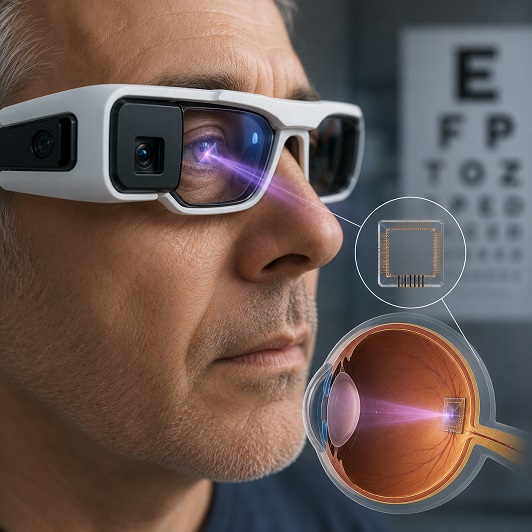
The system combines a tiny, ultra-thin implant placed beneath the damaged part of the retina with a specialised pair of glasses containing a front-facing camera and an eye-facing projector. The glasses project near-infrared light onto the implant, which converts that light into electrical signals capable of stimulating the remaining healthy retinal cells.
Those signals are then processed by the patient’s own visual system, allowing useful central vision to be restored despite the loss of the original photoreceptors.
The glasses also include a zoom function that enlarges letters and other fine detail, making reading considerably easier for many patients.
Science Corp describes the technology as “a novel subretinal photovoltaic implant paired with specialised glasses” featuring “an ultra-thin profile and seamless, wireless integration.”
Clinical Results Show Significant Improvements
The commercial launch follows encouraging results from an international clinical trial published in the New England Journal of Medicine.
The study followed 38 patients across 17 clinical centres in five countries, evaluating whether the system could restore meaningful central vision.
According to Science Corp, patients achieved an average improvement of 25.5 letters on the standard ETDRS eye chart, equivalent to more than five additional lines of vision.
Perhaps more importantly, 84 per cent of participants regained the ability to read letters, numbers and words, restoring practical visual function that had previously been lost.
The company also reports that the implant was positioned beneath the damaged area of the retina “without a decline in mean existing natural vision”, meaning patients did not sacrifice the remaining eyesight they already had.
Importantly, it should be noted here that PRIMA is not a cure for AMD. It restores useful central vision but does not halt or reverse the underlying disease process.
A Milestone For Brain-Computer Interfaces
Although PRIMA is primarily an ophthalmology story, it also represents an important milestone for the wider field of neurotechnology.
Brain-computer interfaces have received growing attention in recent years through projects such as Neuralink, where the focus has largely been on restoring movement, enabling communication and eventually allowing people to interact directly with computers using their thoughts. PRIMA demonstrates that the same underlying technology is already finding practical medical applications in another area, namely restoring sight.
The implant works by converting information from the camera into electrical signals that communicate directly with surviving retinal neurons, effectively creating a specialised brain-computer interface focused on vision.
Science Corp therefore describes PRIMA as “the first BCI device to receive CE marking for form vision restoration.”
That achievement also places the company ahead of several much higher-profile neurotechnology firms in bringing a commercially approved brain-computer interface to patients. Rather than waiting for the more ambitious goals often associated with companies such as Neuralink, PRIMA shows that specialised neural implants are already beginning to deliver practical medical benefits.
The significance extends well beyond blindness. It demonstrates that brain-computer interfaces are moving steadily from experimental research into mainstream healthcare, suggesting the wider neurotechnology revolution may arrive through focused medical treatments before expanding into the broader capabilities that have attracted so much public attention.
Europe Leads Commercial Adoption
The decision to launch in Europe first is also significant. Receiving CE marking enables commercial availability throughout much of Europe before the technology reaches the United States, where Science Corp continues working with the Food and Drug Administration.
The company says PRIMA has already received both FDA Breakthrough Device designation and Humanitarian Use Device designation, which are intended to accelerate access to treatments addressing serious unmet medical needs.
Europe’s regulatory approval therefore places it at the forefront of the first commercial rollout of a technology that many have viewed as belonging firmly in the future.
As Science Corp says: “We are proud to be the first BCI company with a CE-marked device for the restoration of detailed form vision.”
What Does This Mean For Your Business?
For businesses, PRIMA highlights how neurotechnology is beginning to mature from laboratory research into commercially available medical products.
Although today’s application focuses on restoring sight, the same principles underpin a much wider generation of brain-computer interface technologies being developed for conditions ranging from paralysis and spinal cord injury to neurological disease. As these technologies mature, they are likely to create new opportunities across medical devices, software, artificial intelligence, advanced manufacturing and specialist healthcare services.
The launch also reinforces Europe’s growing importance in advanced medical technology commercialisation. Companies capable of navigating demanding regulatory pathways and demonstrating meaningful clinical benefits are increasingly able to bring highly sophisticated technologies to patients years before wider global adoption.
Perhaps most significantly, PRIMA demonstrates that brain-computer interfaces are no longer confined to science fiction or experimental research. They are becoming practical medical technologies capable of restoring lost human abilities, and that transition from research project to commercial healthcare product may prove to be one of the most important developments in medical innovation over the coming decade.