
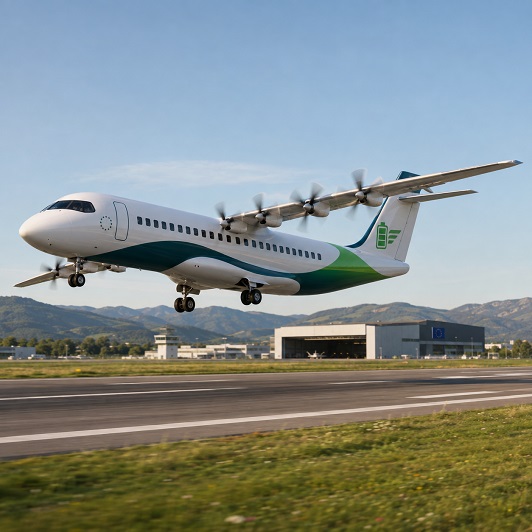
Europe-Built Electric Aircraft Makes Record Flight
The largest battery-electric aircraft ever flown has completed its first successful flight, demonstrating that electric propulsion can now operate at something approaching commercial-airliner scale while highlighting both the enormous potential and the significant limitations still facing cleaner regional aviation.
A Record-Breaking First Flight
Heart Aerospace’s X1 demonstrator, developed by the Swedish-founded aviation company before it relocated its operations to the US, took off from Plattsburgh International Airport in New York on 12 August, completing a 27-minute piloted flight that included taxiing, take-off, climbing, manoeuvring and landing.
The aircraft is certainly substantial. For example, with a wingspan of a massive 106 feet, a length of 76 feet and a take-off weight exceeding 25,000 lb, Heart says the X1 is the largest battery-electric aircraft ever to have flown. During the test, it climbed to 1,100 ft above ground level while its all-electric propulsion system delivered more than one megawatt of power.
Heart’s Founder and CEO Anders Forslund said: “With the first flight of X1, Heart Aerospace has demonstrated electric flight at the scale of a commercial airliner.”
Perhaps the most eye-catching figure, however, is the energy bill. Heart says powering the entire flight required approximately US$5 worth of electricity, providing an intriguing glimpse of how electric propulsion could eventually change the economics of short-distance flying.
Why The US$5 Figure Matters
That US$5 should be treated carefully, since it represents only the electricity consumed during one demonstration flight rather than the total cost of operating an aircraft.
Airlines would still need to pay for pilots, maintenance, airport charges, battery replacement, insurance and the aircraft itself. However, energy represents a significant operating expense in aviation, while jet-fuel prices can fluctuate considerably with global oil markets.
Electricity could potentially make part of that cost both lower and more predictable, particularly on the short regional journeys for which Heart is developing its technology.
Heart expects its eventual commercial aircraft to reduce operating costs by more than 40 per cent compared with older regional aircraft, citing cheaper energy, simpler electric propulsion requiring less maintenance and improved aircraft reliability among the reasons.
The Environmental Opportunity
The potential sustainability benefits are equally important, particularly because aviation remains one of the harder sectors of the economy to decarbonise.
Battery-electric aircraft can operate without burning jet fuel during flight, eliminating the associated direct carbon emissions from their electric operation. Where batteries are charged using increasingly renewable electricity, the overall environmental benefits could become more significant.
Regional aviation is a particularly interesting place to begin because many flights cover relatively short distances, yet conventional aircraft still need to burn fuel throughout those journeys.
Electric propulsion also offers the possibility of quieter aircraft, while lower operating costs could potentially make smaller regional airports and less heavily travelled routes commercially viable.
Forslund believes this could ultimately enable “more affordable, frequent, and cleaner air service to and from airports closer to home”.
The Big Battery Problem
Despite the successful X1 flight, batteries remain the fundamental obstacle preventing large commercial aircraft from simply swapping their jet engines for electric motors.
Jet fuel contains far more usable energy for its weight than today’s batteries, and weight matters enormously in aviation. Adding enough batteries to fly substantially further also makes an aircraft heavier, which in turn requires more energy to keep it airborne.
That explains an important distinction behind Heart’s programme. The X1 demonstrator that has just flown is entirely battery-electric, although the commercial ES-30 aircraft it is helping Heart develop will actually be hybrid-electric.
The 30-seat ES-30 is being designed to combine batteries and electric propulsion with a combustion-powered range extender, allowing Heart to pursue commercially useful regional routes without depending on battery improvements that have yet to arrive.
Rather than undermining the achievement, that compromise illustrates where electric aviation realistically stands today. Batteries can increasingly power larger aircraft, although their weight and energy density still limit the distances those aircraft can practically travel.
From Demonstrator To Airliner
Heart Aerospace, which was actually founded in Sweden but is now headquartered in Los Angeles, is already developing the first pre-production ES-30 at its pilot manufacturing facility in California.
Flight testing is scheduled to begin in 2028, with entry into commercial service targeted for 2031. The aircraft is being developed for certification under the same FAA Part 25 framework governing commercial airliners, meaning substantial testing and regulatory work still lies ahead.
There is certainly commercial interest, with Heart reporting customer commitments from airlines including United Airlines, Air Canada and JSX.
Michael Leskinen, Chief Financial Officer of United Airlines, said electric commercial aircraft have “real potential to deliver a better travel experience for passengers while strengthening our business”.
What Happens Next?
Turning a successful 27-minute demonstration into an aircraft carrying paying passengers will require considerably more than proving electric motors can lift an airliner-sized aircraft.
For example, Heart must successfully develop and test its pre-production ES-30, complete certification, demonstrate commercially acceptable reliability and convince airlines that its promised operating savings can be achieved in everyday service.
Battery development will also be a particularly important element. Improvements in energy density could allow future aircraft to travel further electrically without adding excessive weight, gradually reducing dependence on the combustion range extender and increasing the environmental benefits.
What Does This Mean For Your Business?
For businesses, Heart’s achievement provides an interesting example of how decarbonisation can increasingly be driven by economics as well as environmental targets. If electric propulsion genuinely reduces energy and maintenance costs, airlines could have a strong commercial reason to adopt cleaner aircraft rather than relying solely on regulation to encourage them.
The flight also demonstrates why sustainability breakthroughs need to be viewed realistically. The X1 has not solved aviation’s emissions problem, and Heart’s first commercial aircraft will still use fuel when its range extender is required. What it has demonstrated is that battery-electric propulsion can now operate successfully at a scale that would have seemed extremely ambitious only a few years ago.
The next stage will determine whether that engineering achievement can become a commercially viable aircraft. For example, if battery performance continues improving and Heart can deliver the reliability, certification and operating savings it is promising, electric propulsion could begin making some of aviation’s shortest journeys cleaner long before completely electric long-distance flight becomes practical.