New York Bans AI For Most Schoolchildren For A Year
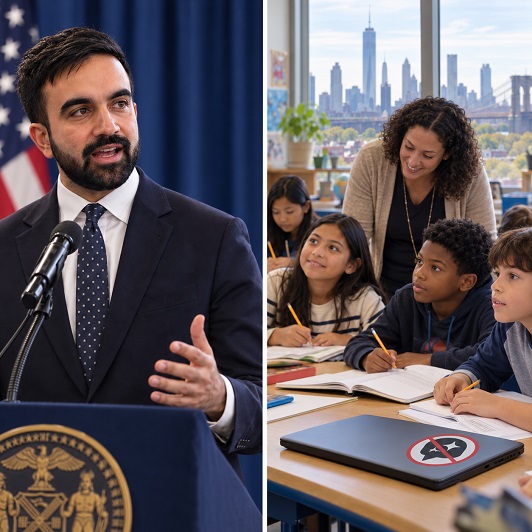
New York City has introduced a one-year moratorium on student-facing generative AI for children from 2-K through eighth grade, affecting nearly 600,000 pupils in the largest US public school system.
Why Has The Ban Been Introduced?
The policy applies throughout the 2026–27 school year and removes student-facing generative AI from elementary and middle schools, including AI functions built into educational software already being used in classrooms. Companion-style AI chatbots are also prohibited across all grades, while teachers can continue using approved AI for activities such as lesson planning and operational tasks.
Mayor Zohran Mamdani has framed the decision as a question of whether technology is actually helping children learn rather than whether schools should automatically adopt whatever becomes widely available. In his public statement, he said: “Just because technology is everywhere doesn’t mean it belongs everywhere.”
The main concern appears to be that younger pupils may begin to rely on generative AI before they have fully developed the underlying skills needed to evaluate what it produces, solve problems independently or learn through discussion with teachers and classmates.
Mamdani put the argument more directly by saying: “The tech industry wants us to believe that AI in early education is not only inevitable, but necessary. We don’t see it that way.”
What’s Being Banned?
The policy is more substantial than simply banning ChatGPT. New York City is reviewing its educational technology and removing or disabling student-facing generative AI functions that do not meet its new standards, while companion chatbots are banned throughout the school system.
The wider technology policy also introduces much tighter guidance around screen use. For example, students in second grade and below (roughly equivalent to Year 3 and below in the UK) will have restricted one-to-one screen time, while recommended daily limits are 30 minutes for grades three to five and 45 minutes for grades six to eight.
The city says educational technology will be assessed more closely for safety, privacy, transparency, learning value and evidence that it produces a genuine educational benefit. This means schools are being asked to judge educational technology on whether it is genuinely suitable and beneficial for children, rather than simply using it because it is available.
Not Banning AI Completely
It should be noted here that New York is not banning AI completely, because the city is taking a different approach with older students. For example, high-school pupils will receive two AI-literacy sessions each year covering issues such as bias, misinformation, ethics and the effect AI may have on future jobs and skills.
Up to 50,000 high-school students will also be allowed to take part in five limited AI pilots, with use restricted to selected classes and supervised by trained teachers. The city says those tools have been chosen according to safety, privacy and educational criteria, while exceptions are also available for assistive technology, multilingual learners and some career-readiness programmes.
This makes the policy less a rejection of AI than an attempt to decide when pupils are ready to use it and under what conditions. Younger children are being asked to build core learning and reasoning skills without generative AI, while older students will increasingly be taught how to understand and question it.
Why Now?
New York is responding to a wider concern that education systems have adopted digital tools faster than they have been able to measure their effects. Generative AI can produce complete answers, essays and explanations within seconds, making it useful as a learning aid but also capable of removing some of the effort through which learning happens.
Privacy is also part of the debate, with Mamdani saying New Yorkers deserve to know that “their children’s data won’t be mined by Big Tech” and that “their children’s growth won’t be compromised for a corporation’s bottom line.”
The policy is deliberately temporary, giving the city a year to study what works before deciding what should follow. A new Technology in Schools Coalition involving students, teachers, parents, unions, elected representatives and experts will review the moratorium and the limited high-school pilots before recommending future policy.
New York Is Not Alone
New York is not the first education system to take this approach. Norway announced a national restriction back in June preventing pupils in grades one to seven from using generative AI themselves, with older children allowed only limited, supervised use, reflecting similar concerns that relying on AI too early could allow pupils to skip important stages in learning.
The comparison suggests the debate is increasingly about ‘when’ children should begin using AI, under what supervision and with what safeguards, rather than whether schools should use the technology at all.
What Does This Mean For Your Business?
The wider lesson for organisations here is that AI adoption doesn’t have to be an all-or-nothing decision. New York is separating situations where the technology may provide genuine value from those where the risks, lack of evidence or possible effect on human development justify greater caution.
Businesses can apply the same principle by deciding which tasks are suitable for AI, which require human judgement and which should remain off-limits until safeguards are stronger. That means assessing privacy, data handling, accuracy and the effect on skills rather than introducing AI simply because competitors are doing so.
New York’s approach also shows the value of limited pilots before wider deployment. Testing AI in controlled environments, measuring whether it actually improves outcomes and keeping people responsible for important decisions can provide stronger evidence than assuming that wider use automatically means better results.
For organisations still deciding how far to take AI, the important question may increasingly be not whether they can use it, but where it genuinely improves the work people are already doing.