
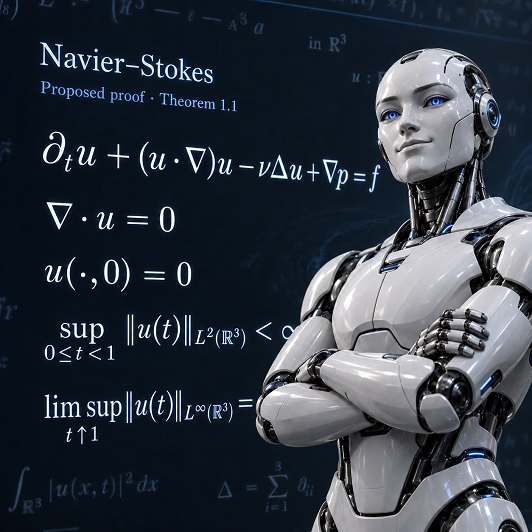
AI Cracks 90-Year-Old Maths Problem In 88 Hours
OpenAI says an internal AI system has solved a mathematical problem that has resisted researchers for roughly 90 years, demonstrating the growing power of automated research while provoking a dispute over credit, transparency and human understanding.
What’s Been Announced?
On 8 September, OpenAI published a proposed solution to the Navier–Stokes existence and smoothness problem, one of seven Millennium Prize Problems identified by the Clay Mathematics Institute in 2000.
The equations describe how liquids and gases move and underpin work including aircraft design, weather forecasting and blood-flow research. The longstanding question concerns whether initially smooth motion in a three-dimensional fluid can develop a mathematical breakdown, even when viscosity helps smooth that motion out.
OpenAI says its system found an example where fluid velocity becomes unbounded within a finite time while total energy remains finite. This would reveal circumstances in which the mathematical description breaks down, rather than suggest that real water can suddenly travel infinitely fast.
How Did It Take Just 88 Hours?
The result came from a substantial research operation using an unreleased model that OpenAI describes as “significantly more capable than GPT‑6 Astra”.
Roughly 10,000 AI agents worked together, exchanging information, running code and exploring different approaches. Researchers directed the effort, moved resources towards promising work and used intermediate findings to guide further attempts.
The agents reached their solution after about 88 hours, having exchanged 2.7 million messages and generated approximately 130 billion output tokens (the units into which AI systems divide text and other output). Formalisation and verification using the Lean proof system (software that checks whether mathematical proofs follow logical rules) then took another 17 hours.
Context
Although 88 hours sounds remarkably quick, thousands of AI agents were working at the same time, drawing on years of mathematical research and substantial computing resources. Human researchers also helped guide the work, so the time taken tells only part of the story about the effort and expense involved.
Has The Problem Really Been Solved?
OpenAI has published both a written proof and a Lean formalisation, making its claim available for examination beyond the company. Formal checking provides a way to test mathematical reasoning, although specialists still need to scrutinise what has been proved and develop an accessible understanding of it.
Also, there seems to have been a significant development since the initial coverage. On 11 September, the Clay Mathematics Institute welcomed the apparent resolution while explaining that its process for evaluating achievements and assigning credit would take time.
Questions
Some have questioned whether OpenAI’s solution counts because it involves a force acting on the fluid, rather than the fluid moving without outside influence. However, the official rules allow this, provided the force meets certain mathematical conditions, so its inclusion does not itself weaken OpenAI’s claim to have solved the problem.
OpenAI says: “We do not intend to claim the Millennium Prize for this result.” That decision alone does not establish whether the proof meets the criteria.
Why Is There A Dispute Over Credit?
The announcement coincided with related research by NYU mathematician Tristan Buckmaster and Levent Alpöge, an Anthropic employee. Their personal collaboration used AI tools, including Codex, to advance work on fluid equations.
Buckmaster questioned whether OpenAI had benefited from unpublished research that he and Alpöge had shared with Codex, OpenAI’s AI coding assistant, although he acknowledged that he did not know whether this had happened. He also said OpenAI had pressured him over when to publish their findings and asked him to remove Alpöge’s name as an author from a proposed paper.
Not surprisingly, OpenAI denies accessing their unpublished work. In a 10 September update, it said an investigation had established that Buckmaster’s recent Codex prompts could not have influenced the system, including through training. The competing accounts leave questions about research relationships and credit that checking a mathematical proof cannot settle.
Why Mathematicians Want More Than Answers
The controversy comes amid wider concerns raised in an open letter signed by 25 winners of the Fields Medal, one of mathematics’ most prestigious awards, who warn that competition between AI companies could leave too little time for mathematicians to check, explain and build on new discoveries.
As the letter explains, “solving problems is only a tool and proxy for achieving the primary goal of conceptual understanding and insight”. Its concern is that rushed announcements can leave insufficient time to explain methods, acknowledge earlier work and help others build on discoveries.
In short, the signatories are saying that they recognise AI’s potential to accelerate research, but argue that producing answers must still serve the wider purpose of developing understanding.
What Does This Mean For Your Business?
For businesses, the immediate significance is AI’s growing ability to undertake sustained, difficult work when connected to tools, sufficient resources and expert direction. This result does not establish that ordinary business AI services can deliver comparable breakthroughs cheaply.
Organisations exploring AI research should assess the cost of reaching a result, the effort required to verify it and whether employees can understand and apply what emerges. Contracts covering confidential inputs and ownership also deserve attention before valuable unpublished work enters external systems.
A faster answer has commercial value when it is reliable and usable. Preserving the expertise needed to challenge that answer remains part of the investment.
There is also a practical question about what happens to the time AI saves. For example, if employees use it to test findings, explore alternatives and understand why a solution works, the business can gain knowledge as well as speed. If that time is simply removed from the process, it risks becoming dependent on answers that nobody in the organisation can confidently explain or adapt when circumstances change.