
AI Boom Could Leave An E-Waste Trail Around Earth
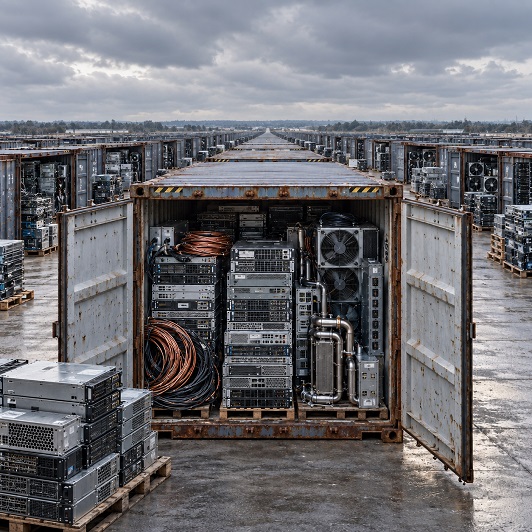
The expansion of AI could leave enough retired electronic equipment to fill shipping containers stretching six times around Earth, according to a new report warning that the technology’s environmental footprint extends far beyond electricity and water consumption.
What Has The Report Found?
The Basel Action Network (BAN), a non-profit organisation campaigning against toxic waste and irresponsible waste exports, estimates that AI-driven equipment retirements could total between 395 million and 617 million tonnes from 2025 to 2050.
To put that volume of waste into perspective, The Coming AI Waste Wave estimates that it would fill between 15 million and 23 million shipping containers, with a line of 20 million stretching roughly 244,000 kilometres, enough to circle Earth about six times!
However, how much of that equipment eventually becomes waste will depend on how quickly AI infrastructure expands, how often devices are replaced and whether older hardware is reused. The figures therefore show the potential scale of the problem if those assumptions hold, rather than the amount certain to end up in landfill.
Why Count More Than AI Chips?
Much of the discussion about AI hardware focuses on graphics processing units, or GPUs, the specialised chips used to train and run models. However, those chips need servers, networking equipment, electricity distribution, backup power and cooling systems to function.
BAN estimates that servers, accelerators and racks account for only 13 per cent of the equipment mass in its reference data centre. Across all five equipment categories, it calculates approximately 7,000 tonnes for a facility with 100 megawatts of capacity.
The report argues that overlooking this supporting infrastructure understates the eventual disposal challenge, explaining, “Counting servers alone is like estimating the scrap value of an automobile factory by weighing only the engines.”
This wider view matters because an upgrade can affect more than the computing hardware. For example, installing more powerful systems may also require changes to electrical connections and cooling, potentially displacing equipment that still works but no longer meets the facility’s requirements.
Why Might Equipment Be Replaced So Quickly?
It seems that BAN’s calculations assume that servers, accelerators and racks are replaced every 2.5 years on average, with networking equipment lasting 3.5 years, power distribution equipment eight years, and backup power and cooling systems five years. It’s worth noting that some of these timings come from industry sources and others are BAN’s own estimates, so they actually describe the replacement patterns used in the model rather than a schedule followed by every operator.
The concern is that pressure to keep up with newer AI systems could lead businesses to replace equipment while it still has some useful life left. That creates demand for more materials and energy to manufacture replacements, making it important to find another use for the outgoing hardware wherever possible and recycle it responsibly when reuse is no longer practical.
The Report Also Counts Phones And PCs
BAN also says it expects AI adoption to encourage people and businesses to replace computers, phones and telecommunications equipment sooner, adding to the waste generated outside data centres. For example, some new AI features need more powerful processors or extra memory, while others may simply tempt customers to upgrade even though their existing devices still work.
However, missing out on a new feature doesn’t make a device unusable, and many cloud-based AI services can still run through older equipment. How much extra replacement AI will cause is therefore difficult to predict, as BAN acknowledges in its report, saying “very little data exists to quantify this segment.” Its higher estimate actually includes upgrades driven by the appeal of new features, making consumer choices part of the projected waste total.
How Certain Is The Forecast?
The scale of BAN’s forecast also really depends on data-centre capacity continuing to grow by approximately 8.8 per cent a year through 2050. Sustaining that pace for decades would mean considerably more equipment being installed and eventually replaced, while the report’s own calculations show that slower growth would produce much lower waste estimates.
What happens to that equipment after replacement will also make a difference, because a server removed from one facility may still be suitable for less demanding work elsewhere. BAN says it plans to examine reuse, refurbishment and repurposing in a later instalment, leaving an important question about how much retired hardware could remain useful rather than immediately becoming waste.
That said, some companies are already working on this. For example, Microsoft has reported reusing or recycling 90.9 per cent of its servers and components in 2024, although combining those activities in one figure does not show how much equipment continued to be used. The wider picture is somewhat less encouraging, with the UN’s Global E-waste Monitor finding that only 22.3 per cent of e-waste generated worldwide in 2022 was documented as formally collected and recycled, highlighting how much work is needed even before AI adds to the volume.
What Does This Mean For Your Business?
For businesses, the practical starting point is to question whether an AI project genuinely requires new equipment. Purchasing decisions should really follow a demonstrated operational need, with repair, memory upgrades and reassignment considered before replacement. Keeping suitable devices in productive use can reduce both costs and demand for newly manufactured hardware.
When buying equipment or selecting cloud services, organisations should also ask about expected lifetimes, repairability, spare parts and what happens when systems are retired. A recycling claim is more useful when it explains how much equipment is reused, which materials are recovered and how downstream contractors are checked, rather than simply promising that nothing reaches landfill.
The report’s strongest message is really that sustainability planning must begin before purchasing and construction. Cleaner electricity can’t remove the material footprint of repeated replacement, while recycling alone can’t preserve all the value invested in making equipment. Businesses can act now by extending useful life and making end-of-use arrangements part of the original investment decision.