
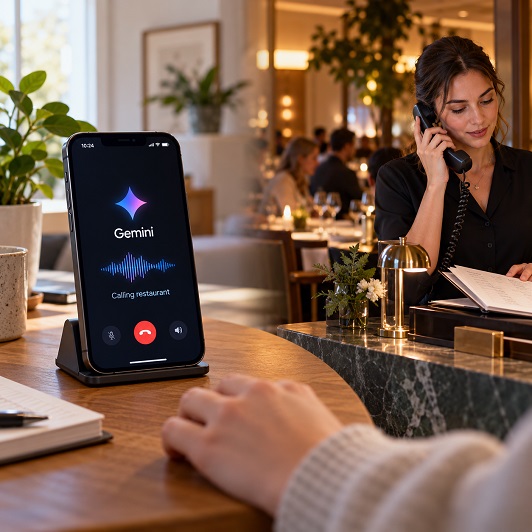
Gemini Starts Making Calls For Customers
Google is testing a Gemini feature that can telephone businesses, ask questions and arrange bookings on a customer’s behalf, potentially saving people time while requiring businesses to decide how they handle conversations with an AI assistant.
What Is Google Testing?
The feature, called Call for Me, allows Gemini to handle routine telephone conversations, including checking whether a shop has an item in stock, requesting a service quote or changing a reservation.
For example, instead of simply dialling a number, Gemini can navigate automated menus, wait on hold and speak to the person who answers. This takes the assistant beyond providing information on a screen and into conversations that can result in actual bookings or changes to someone’s plans.
Who And Where?
The experiment is initially restricted to adults in the US using Pixel 11 phones with a US SIM card, a Google AI subscription and the public beta version of the Phone by Google app. English must be selected as the device language, and calls currently go only to US numbers, so this is not a UK launch.
How Does A Call Work?
With this new feature, users describe what they want Gemini to achieve, including relevant dates, preferences and alternatives. Someone arranging dinner could, for example, specify the number of diners, preferred time and whether a later booking would be acceptable.
Before dialling, Gemini presents the task, telephone number and information it intends to share, such as the customer’s name and contact details, to the user for approval. The user can then correct those instructions accordingly before approving the call, which uses their own mobile number and network, with normal carrier charges applying.
That preparation is important because everyday conversations rarely follow a fixed script. For example, a restaurant might offer a different time or ask about seating, leaving the assistant needing enough guidance to respond without guessing what the customer would accept.
Google’s instructions therefore advise users to “Be specific about what you want to achieve”, including preferences and alternative options.
Will Businesses Know They Are Speaking To AI?
Google says every call begins with Gemini identifying itself as an AI assistant calling on a recorded line and giving the user’s name. Its additional terms prohibit attempts to hide or bypass that disclosure.
Also, users can follow a live transcript or listen to the conversation, with their microphone initially muted. If the discussion becomes complicated, they can take over, at which point Gemini announces the handover and leaves the call.
Once the call finishes, the user receives a summary and can review the recording and transcript. These controls provide ways to check what happened, although they don’t guarantee that the assistant understood every detail correctly. Worryingly, Google’s terms acknowledge that it “may occasionally misinterpret responses or provide inaccurate information during a call”.
Where Are The Limits?
Although Gemini can arrange bookings, it can’t actually make payments, complete financial transactions or share details such as credit card numbers, passwords or health information. Emergency calls and telemarketing are also excluded, and daily calling limits apply.
One particularly important restriction concerns who can use it and why. Google’s terms state, “You can only use the Feature for personal reasons”, excluding calls made on behalf of businesses, government agencies or law enforcement.
For companies, that means the immediate issue is receiving calls from customers’ assistants, rather than introducing Gemini as an employee’s telephone representative. A personal reservation request falls within the intended use, whereas asking it to conduct company purchasing calls would conflict with the current terms.
What Happens To The Conversation?
Recording creates another consideration for the business answering the phone. Google says transcripts are sent to its servers, while a copy of the transcript and audio recording is stored in the user’s Phone app call history.
Its privacy guidance states, “We don’t use these audio recordings or transcripts to train Google’s AI models.” It also says audio recordings are not stored on Google’s servers, and users can delete their calling activity and local records.
These distinctions are important because a conversation can still leave records outside the business even when it is not used for AI training. Businesses that don’t want automated calls from Gemini users can opt out through Google’s published process.
What Does This Mean For Your Business?
For UK businesses, this is really more of a development to watch than an available service to deploy, but it does raise a useful question about how staff would respond to an assistant representing a customer. Clear procedures should distinguish routine enquiries from requests involving personal records, account changes or commitments requiring further checks.
An assistant giving a customer’s name should not automatically be treated as proof that it has permission to access their account. Staff should retain existing identity checks, confirm important details and have a straightforward way to request direct contact with the customer when a conversation exceeds what they can safely agree.
Essentially, the potential benefit seems to be easier access to businesses for customers who struggle to find time for calls. However, success should really be judged by whether enquiries and bookings are completed accurately, without creating extra work correcting misunderstandings, rather than simply by how convincingly the AI holds a conversation.