
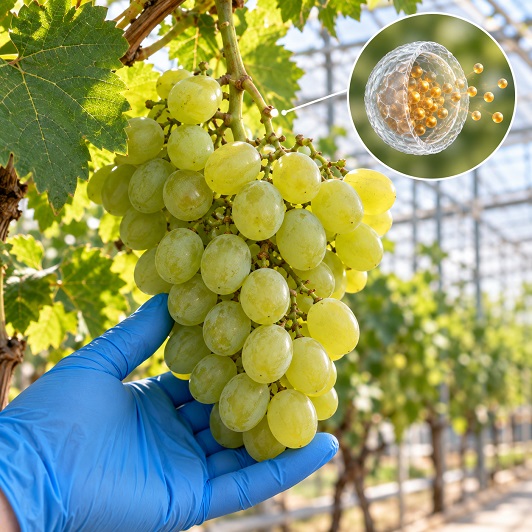
Tiny Particles Show Promise For Better Grape Harvests
Researchers in Türkiye have used biodegradable nanoparticles to deliver a plant growth hormone to grapevines, producing heavier bunches and stronger berry attachment in a small trial that suggests a possible way to improve crop production and reduce food waste.
Why Does The Hormone Need Protection?
Farmers already use gibberellic acid, a manufactured version of a naturally occurring plant hormone, to influence flowering, fruit development and growth. In grape production, it can help increase berry size and improve the shape and weight of bunches.
However, the hormone breaks down readily when exposed to heat, light and certain chemical conditions. This can reduce its effectiveness and contribute to the need for repeated applications, increasing the resources required to achieve the intended result.
The researchers investigated whether enclosing the hormone inside tiny biodegradable particles could improve its delivery. Their study, published recently in the Journal of the Science of Food and Agriculture, examines how this approach affects Thompson Seedless grapes.
How Do The Particles Work?
The team used PLGA, a biodegradable polymer also used in medical drug delivery, to carry the hormone. The loaded particles measured approximately 218 nanometres across, making them far too small to see with the naked eye.
Instead of exposing all the hormone immediately, the polymer holds it within its structure and allows it to escape gradually. This controlled release is intended to protect the active ingredient and keep it available to the plant for longer.
Laboratory tests found that approximately 65 per cent of the enclosed hormone was released within 96 hours. That demonstrates gradual delivery under the test conditions, although it doesn’t establish exactly how the formulation behaves on vines exposed to changing weather.
What Did The Researchers Test?
The grape experiment took place in a glass greenhouse at Selçuk University in Türkiye. Researchers selected 24 flower clusters and divided them between four treatments, with six clusters in each group.
They compared untreated clusters with those receiving the hormone alone, empty nanoparticles or nanoparticles containing the hormone. Both hormone treatments used the same concentration, and each treatment was applied once at the start of flowering.
This makes the study useful for comparing the formulations, but it didn’t test whether farmers could use less hormone or spray less frequently. Despite references to field applications in the summary, the detailed methods describe a greenhouse experiment.
How Much Did The Grapes Improve?
Bunches treated with the loaded nanoparticles averaged approximately 301 grams, compared with 147 grams for those receiving the hormone alone. That represents the reported 104 per cent increase, while average bunch length rose from about 13 centimetres to 22 centimetres.
However, the statistical analysis should be treated with some caution. For example, although the nanoparticle group produced significantly heavier bunches than the untreated group, the paper didn’t really establish a statistically significant weight difference between the nanoparticle treatment and the hormone alone.
The results therefore suggest quite a promising improvement rather than conclusive proof that the formulation reliably doubles production. Larger trials would help establish whether the difference persists across growing conditions, seasons and grape varieties.
The researchers also reported increases of approximately 15 per cent in berry weight and 13 per cent in width compared with the hormone alone. These measurements concern the sampled fruit, rather than total output from a commercial vineyard.
Could It Reduce Food Waste?
The treatment also increased the force needed to detach grapes from their stalks by approximately 25 per cent compared with the hormone alone. Stronger attachment could matter commercially because grapes falling from bunches during handling and storage can reduce saleable produce.
However, the researchers measured attachment strength after harvesting, rather than following fruit through storage, transport and retail. Reduced food waste is therefore a potential benefit that still needs testing through the supply chain.
The researchers describe the approach as promising for the “more efficient use of agrochemicals”. Establishing its overall environmental value would also require examining manufacturing, energy use and what happens to the particles after application.
It’s worth noting also that biodegradability is relevant, but it doesn’t by itself demonstrate that the complete treatment has a smaller environmental footprint. The laboratory preparation involved solvents, centrifugation and freeze-drying, which would need consideration when developing an affordable commercial process.
What Does This Mean For Your Business?
For growers and food suppliers, the study suggests that improving how an existing treatment reaches a crop could be as valuable as developing a new active ingredient. The next step is evidence from larger trials measuring saleable harvests, treatment costs and losses after picking, so purchasing decisions can reflect practical results.
Businesses assessing sustainability claims should also ask what was actually measured. Heavier bunches, stronger attachment and biodegradable materials are encouraging findings, but none alone proves lower emissions, reduced chemical use or less waste. Those benefits need comparisons covering production, application and the journey from farm to customer.
The wider opportunity here is to make better use of resources already invested in growing food. If controlled delivery produces more usable fruit without adding disproportionate costs or environmental impacts, it could benefit both growers and buyers. This study provides a reason to investigate further, with commercial value depending on whether the improvements survive beyond the greenhouse.