
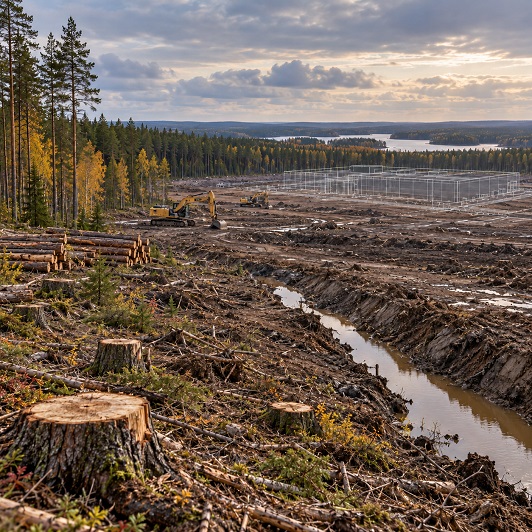
Google’s Forest Clearance Exposes Data Centre Costs
Google’s clearance of hundreds of hectares of Finnish forest for planned data centres has prompted regulatory intervention and public anger, highlighting environmental costs that begin long before AI infrastructure starts consuming electricity.
What Happened?
On 6 October, Finland’s Licensing and Supervision Authority, known as LVV, called on Google subsidiary Tuike Finland Oy to stop environmentally significant work at two planned data centre sites because the required environmental impact assessments were still unfinished.
By then, extensive forest clearance had already taken place at Muhos and Otanmäki, in the municipality of Kajaani. Finnish broadcaster Yle reports that 330 hectares had been cleared at Muhos and just under 200 hectares at Kajaani (the widely reported figure of 250,000 trees removed at Muhos is an estimate, rather than an official count).
The work also included soil removal, drainage changes and other preparations, raising concerns about environmental damage beyond the loss of trees. Google’s subsidiary subsequently confirmed that it had stopped preparatory work at both sites.
Why Should Assessment Come First?
An environmental impact assessment is meant to establish how a development could affect its surroundings before major work begins. This gives authorities and local communities a chance to examine the plans, consider alternatives and identify ways to prevent damage.
LVV’s concern is that clearing land before completing the assessment limits those choices. For example, once trees have been felled or drainage changed, it may be too late to avoid some of the harm the assessment was supposed to identify.
The regulator has therefore called for activities such as tree removal, excavation and road construction to stop while the assessments are completed. Planning, surveys and other work with minor, easily reversible effects can continue, so the projects have not been cancelled.
Why Is Water Now A Concern?
The consequences of clearance can extend beyond the development boundary, particularly where disturbed ground changes what flows into nearby waterways. At Muhos, LVV’s latest findings make this more than a question of how the landscape looks.
In its 22 October update, the regulator highlighted risks associated with sulphide-bearing ground. For example, excavation and drainage can expose these materials to oxygen, potentially increasing acidity and metal concentrations in runoff. Monitoring results supplied by the company already showed changes indicating acidification.
To address these risks, it’s understood that LVV has given the company until 5 November to submit a detailed plan explaining how it will manage water leaving the site, including during heavy rain and snowmelt, and arrange independent monitoring. The regulator also says the drainage work needs a water permit. Separately, it has asked police to investigate the Muhos project, although no finding of criminal guilt has been established.
Displaced Wildlife
Residents in Otanmäki say wolves have entered the village since the forest was cleared, raising concerns that the work has displaced wildlife and brought animals closer to homes.
Although those accounts have not been independently verified, they highlight local concerns about the loss of surrounding habitat. Establishing how the clearance has affected wildlife would require further investigation, including whether it has changed where animals find food and shelter.
What Does Google Say?
Google’s Finland country manager, Antti Järvinen, has apologised for the clearances, saying the company believed it was complying with the law. Google has since confirmed that preparatory work has stopped at both sites while it responds to the regulator’s requirements.
The sites are part of a wider €13 billion investment programme for 2027–2028, covering Hamina, Kajaani, Muhos and Vaala. Google says the investment will help meet demand for services including Search, Maps and Gemini, as well as supporting energy projects and local communities.
Google also points to its existing operation in Hamina, where it converted a former paper mill into a data centre and introduced heat recovery to supply the local district heating network. That shows how data centres can make use of existing industrial sites and provide useful heat, but the new developments need their own evidence of environmental benefits and safeguards.
Can Replanting Repair The Damage?
Google’s plans include planting trees across 130 hectares at Muhos, compared with the 330 hectares reportedly cleared. Replanting could help restore parts of the site, although new trees will take time to grow and cannot immediately replace the habitat that has been lost.
The results will depend on which species are planted, how well they survive and whether the surrounding soil and water conditions recover. Monitoring those changes over time should provide a clearer picture of restoration than simply reporting how many trees have been planted.
What Does This Mean For Your Business?
For businesses choosing cloud and AI suppliers, the case shows why sustainability checks need to cover more than electricity consumption. An efficiently run data centre can still have significant environmental costs if its construction damages habitats or nearby waterways.
Customers should therefore look for evidence of how suppliers choose sites, assess potential harm and check whether restoration work succeeds. Company-wide environmental targets can help explain a supplier’s ambitions, but information about individual developments shows how those commitments are being put into practice.
At the Finnish sites, the next steps are to complete the assessments and meet the regulator’s requirements, including those concerning water protection. The dispute demonstrates why these questions need answers before major clearance begins. Data centres can, of course, bring investment and useful services, but sustainable development depends on preventing avoidable damage as well as making the finished facilities efficient.