
A New Way To Clean Forever Chemicals
Scientists have developed what could become one of the first practical ways to remove harmful “forever chemicals” from contaminated farmland at scale, combining plant-based clean-up with carbon removal in an approach that could make environmental remediation far more affordable while helping tackle climate change.
What Problem Are Scientists Trying To Solve?
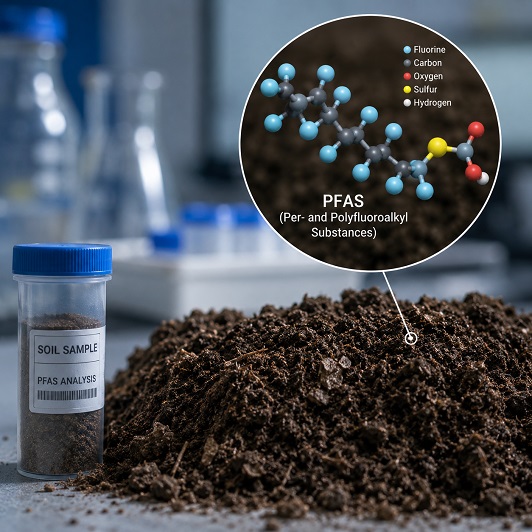
Per- and polyfluoroalkyl substances (PFAS), commonly known as forever chemicals, have become one of the world’s most persistent environmental pollutants.
Used for decades in products ranging from non-stick cookware and waterproof clothing to firefighting foams and industrial manufacturing, PFAS resist natural breakdown and can remain in soil and water for many years. Their persistence has led to growing concern because exposure has been linked to a range of health issues, including certain cancers, liver damage, thyroid disease and immune system problems.
One of the less widely recognised sources of contamination comes from sewage sludge, often referred to as biosolids, which has been spread on agricultural land as fertiliser for decades in many countries. While providing valuable nutrients, this sludge has also introduced PFAS into farmland, where the chemicals can move into crops, groundwater and eventually the food chain.
As the Yale University research team explains in its paper: “PFAS contamination of agricultural soils represents a pervasive and persistent environmental challenge.”
A Different Way To Clean Contaminated Land
Traditional methods for cleaning PFAS-contaminated soil are both disruptive and extremely expensive. They often involve excavating large volumes of soil or heating it to very high temperatures, approaches that can cost hundreds of thousands or even millions of dollars per hectare while leaving farmland temporarily unusable.
Researchers from Yale University have instead proposed an integrated approach that works with the land rather than removing it.
The process begins by applying finely crushed alkaline rock to contaminated fields. This raises the soil’s pH, making key PFAS compounds more mobile and easier for certain plants to absorb.
Farmers then grow crops known to take up PFAS efficiently, including hemp and certain grasses. Once harvested, the contaminated biomass is heated through a process known as pyrolysis. The high temperatures destroy the targeted PFAS while producing biochar, a stable carbon-rich material that can be returned to the soil to help reduce further PFAS movement and improve soil health.
The researchers describe the approach as combining “phytoremediation, biochar production, and enhanced weathering to simultaneously remove PFAS from soil, immobilise residual contamination, and achieve durable carbon dioxide removal.”
Faster, Cheaper And Better For The Climate
One of the most significant findings is that the different elements reinforce one another. For example, the study found that managing soil pH accelerated the removal of PFOS, one of the most common and tightly regulated PFAS compounds, reducing remediation times by more than a decade under typical contamination levels.
The economics also appear promising. The researchers estimate median remediation costs of around US$1,460 per hectare per year, more than an order of magnitude lower than conventional techniques, which often cost between US$0.8 million and US$1.6 million per hectare.
Unlike traditional clean-up methods, the proposed system also delivers significant environmental benefits. Applying crushed rock helps remove carbon dioxide from the atmosphere through enhanced weathering, while biochar locks carbon into the soil for the long term.
National modelling suggests that, if widely adopted across PFAS-contaminated US farmland, the approach could remove around 10.5 million tonnes of carbon dioxide each year, equivalent to approximately 4 to 6 per cent of the country’s 2050 carbon removal target.
Helping Farmers Rather Than Displacing Them
Another important aspect of the research is that it aims to keep farmland productive. For example, conventional remediation often requires contaminated land to be excavated or taken out of agricultural use altogether. By contrast, the Yale approach allows farmers to continue managing their land while progressively reducing contamination.
The researchers note that the strategy “empowers the communities most impacted by contamination—farmers—to directly remediate their land while potentially maintaining productive use.”
The study also highlights how future improvements could make the process even more effective. Researchers believe better PFAS-absorbing plant species, together with advances in crop breeding and biochar production, could further reduce costs and shorten remediation times.
Not A Complete Solution Yet
Although the findings are encouraging, the researchers are careful not to present the approach as a complete answer to the PFAS problem.
The work is essentially based on modelling supported by experimental data, and large-scale field deployment will still need to demonstrate how the system performs under different soil types, climates and farming conditions. Questions also remain about the long-term stability of biochar’s ability to immobilise PFAS and how the approach should be adapted for heavily contaminated sites.
The researchers therefore describe their work as providing “a viable pathway to restore contaminated farmland, mitigate PFAS exposure risks, and contribute meaningfully to national climate mitigation goals”, rather than a finished commercial solution.
What Does This Mean For Your Business?
For businesses, the research demonstrates how environmental innovation is increasingly addressing multiple challenges at the same time rather than solving one problem in isolation. In this case, the same technology has the potential to reduce hazardous pollution, restore agricultural land, protect food production and remove carbon dioxide from the atmosphere.
The work also highlights growing commercial opportunities in environmental remediation. As governments strengthen regulation around PFAS and other persistent pollutants, demand is likely to increase for technologies that can deliver practical, scalable and cost-effective clean-up without disrupting productive land use. Companies involved in agriculture, environmental services, carbon markets and green technology may therefore find new opportunities emerging as these solutions move from research into commercial deployment.
More broadly, the study reflects a wider change in sustainable innovation. Increasingly, the most valuable environmental technologies are those capable of delivering several measurable benefits at once, combining pollution reduction, climate mitigation, resource recovery and economic viability into a single integrated solution. As sustainability moves from compliance to competitive advantage, approaches like this are likely to become an increasingly important part of the transition to a lower-impact economy.