
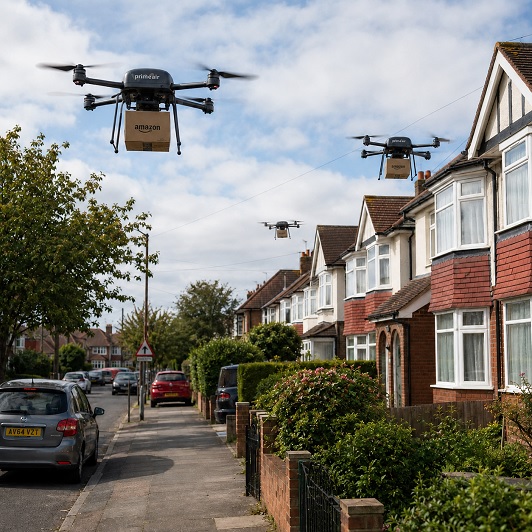
Amazon Expands Drone Delivery Sixfold
Amazon is preparing to expand Prime Air drone delivery to nearly 500 US cities and towns by the end of 2026, while its only UK operation remains tightly restricted to around 100 deliveries a day, highlighting how quickly autonomous delivery can scale when technology, regulation and public acceptance move at different speeds.
Why Is Amazon Expanding Prime Air?
Amazon says Prime Air is moving from a limited service towards something much closer to mainstream logistics in the United States.
The company currently operates from 11 locations across 10 US metropolitan areas, including Phoenix, Tampa, Detroit, Houston, Dallas and Waco, but plans to increase that footprint roughly sixfold by the end of the year.
David Carbon, vice president of Amazon Prime Air, said: “We’ve already delivered hundreds of thousands of packages to customers by drone this year, and by the end of 2026 we plan to reach customers in nearly 500 cities and towns.”
The appeal seems to be fairly straightforward. Prime Air offers delivery in as little as 30 minutes for millions of eligible items, including groceries, electronics, cosmetics, medicines and household products. Amazon says more than 60 per cent of the items customers buy most frequently are light and small enough to be delivered by drone.
For Prime members, drone delivery is free on orders of US$50 or more, while smaller Prime orders cost US$2.99 and non-Prime customers pay US$4.99.
How Does The Drone Delivery Work?
Customers in eligible areas see drone delivery as an option during the normal Amazon checkout process and select a suitable delivery point at their property. Once the drone arrives, it checks that the area is clear of people, pets and vehicles before lowering the package.
Amazon’s current MK30 aircraft use onboard cameras and sensors for navigation and obstacle detection, with data processed by the drone rather than streamed to a human operator. Its Detect-and-Avoid technology continuously monitors the surrounding airspace and environment, allowing the aircraft to make real-time decisions independently.
Amazon describes the system as being similar to “a trained pilot who scans the surrounding airspace”, although recent incidents show why autonomous systems still need to prove themselves under unpredictable real-world conditions.
Moving Much More Slowly In Britain
Amazon recently launched Prime Air in Darlington, making it the company’s first drone-delivery operation outside the United States, but the scale is far more limited.
Customers within roughly 7.5 miles of the fulfilment centre can receive eligible packages by drone, but current operating conditions restrict flights to weekdays, daylight and suitable weather, with a maximum of 10 flights an hour and around 100 deliveries a day.
In other words, although the technology is broadly the same, the regulatory environment is very different from the US.
For example, routine drone delivery requires aircraft to operate Beyond Visual Line of Sight, meaning the drone can fly beyond the distance at which the operator can physically see it. UK regulators are still working through how such aircraft can safely share airspace with conventional aviation, so services such as Prime Air remain tightly controlled.
Safety Will Decide How Fast This Grows
As might be expected, Amazon says safety is its highest priority and points to its US Federal Aviation Administration Part 135 certification, the framework used for commercial air carriers, as evidence of the oversight applied to Prime Air.
The drones are designed to operate in light rain and a range of temperatures, while Amazon says the sound during delivery is quieter than an idling delivery truck and lasts for around 30 seconds.
Even so, recent incidents demonstrate why regulators remain fairly cautious. For example, two Amazon drones struck a crane in Arizona in 2025, another hit an internet cable in Texas, and an MK30 came down in a garden in Darlington in July after reportedly contacting an object extending above a moving vehicle. The Darlington incident is being investigated by the Air Accidents Investigation Branch.
Amazon’s expansion plans therefore arrive alongside a continuing process of proving that autonomous delivery can operate reliably at scale rather than simply performing well under controlled conditions.
What Does This Mean For Your Business?
The important point for businesses is that drone delivery is beginning to move beyond demonstration projects and into real logistics networks, particularly in the United States.
If Amazon can make 30-minute aerial delivery commercially viable across hundreds of communities, customer expectations around delivery speed could change again, especially for urgent, lightweight items such as medicines, electronics and replacement parts.
The difference between the US and UK is also an important point to consider here. New technology doesn’t scale just because it works, with regulation, safety, infrastructure, insurance and public confidence all influencing how quickly a technically successful idea becomes commercially useful.
For UK businesses, widespread drone delivery is unlikely to arrive overnight, but autonomous systems are steadily moving into delivery, warehousing and transport. Organisations that depend heavily on logistics should start considering how those changes could affect costs, customer expectations and the design of future supply chains.
Amazon’s expansion seems to suggest the question is becoming less about whether autonomous delivery can work and more about where regulators and customers will allow it to operate at meaningful scale.