
Anthropic Takes AI Into The Biology Lab
Anthropic, the company behind Claude, has confirmed that it operates a physical biology laboratory in the San Francisco Bay Area, bringing its AI research into experiments that could help test scientific ideas while raising questions about oversight, transparency and biological safety.
What Has Been Revealed?
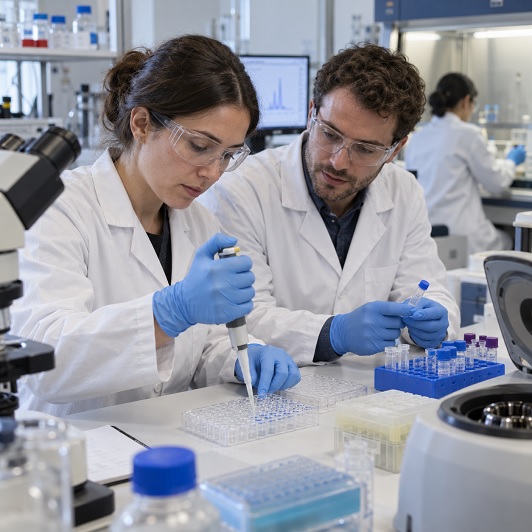
Following a report by Reuters, Anthropic has confirmed that it operates a ‘wet lab’ in the San Francisco Bay Area, where researchers conduct physical experiments with biological materials to test ideas that computer analysis alone cannot verify.
Anthropic has described its focus as fundamental biology, while saying the facility is not specifically for drug discovery. That leaves room for research relevant to future medicines, but doesn’t establish that the company is developing its own drugs.
Details are few and far between at the moment, including the lab’s size, opening date and specific projects. However, it’s thought its work involves both internal facilities and external partners, while laboratory automation remains at an early stage (with human oversight still essential).
Why Does An AI Company Need A Laboratory?
AI can search scientific literature, analyse data and propose experiments, but a convincing prediction doesn’t establish how a biological system will behave. Physical testing provides evidence that can confirm an idea, expose a mistake or suggest a different explanation.
That creates a possible reason for an AI developer to work more closely with experimental science. Access to laboratory results could help Anthropic understand where its models are useful and where their reasoning breaks down, rather than judging progress only through computer-based tests.
Anthropic acknowledges the difference in its published research, explaining that “validating that data in a wet lab” still takes weeks. Faster analysis may therefore accelerate part of a research project without removing the time needed to establish whether its conclusions hold up.
What Has Its Research Shown?
In August, Anthropic reported results from work designing protein binders, small proteins intended to attach to selected target proteins. This is relevant to early drug research because binding to a biological target is part of how many medicines work.
According to the company, Claude produced successful binders for 14 of 15 targets. External evaluators Adaptyv Bio and Twist Bioscience manufactured and tested the designs, providing experimental evidence beyond the models’ predictions.
Those findings illustrate why laboratory access matters, but they shouldn’t be presented as results from the newly disclosed facility. They also concern an early research task, rather than proof that a proposed treatment is safe or effective in patients.
How Does Claude Science Fit In?
The laboratory forms part of a broader expansion into scientific work, including Claude Science, which Anthropic launched in June. The software brings research tools, data analysis and computing resources into one environment, helping scientists work across systems that would otherwise require considerable manual coordination.
A feature is the record of how an output was produced. Anthropic states, “Every output carries an auditable history of how it was made, so you can validate and reproduce the results.”
That history matters because researchers need to examine the inputs, code and assumptions behind a finding. It can make verification easier, although a traceable process still needs scientific scrutiny before its conclusions are accepted.
How Is Anthropic Handling Biological Risks?
The same capabilities that support legitimate research can also be misused, making access controls part of the story. On 17 September, Anthropic introduced its Life Sciences Verification Program, offering researchers more permissive biology access following checks on their credentials, security and ethical oversight.
Standard access covers most research needs, while higher-risk work requires additional approval tied to individual projects. Anthropic says these arrangements address threats including compromised accounts, malicious insiders and agents taking dangerous actions outside their intended tasks.
The programme uses monitoring across activity patterns and requires 30-day data retention. Anthropic says this information cannot be used for model training or accessed by its life sciences research teams. These are safeguards for model access, however, and do not establish what physical containment or procedures apply inside its own laboratory.
What Does This Mean For Your Business?
For businesses using AI in research, engineering or product development, the lesson is that generating ideas faster only helps if those ideas can be tested reliably. Investment decisions should include the cost and time needed for validation, with clear measures of whether AI improves the final result rather than simply producing more possibilities.
This story also highlights why suppliers’ data arrangements deserve scrutiny when they conduct research themselves. Organisations sharing unpublished findings should understand what information is retained, who can access it and how ownership is handled, particularly where monitoring requirements differ from their normal expectations of confidentiality.
As AI moves closer to physical operations, responsibility must remain clear at each stage. Staff need authority to challenge a proposal, prevent an unsuitable action and investigate unexpected results. Anthropic’s laboratory makes the potential more tangible, but dependable progress will still rest on evidence, specialist judgement and controls that work beyond the screen.