
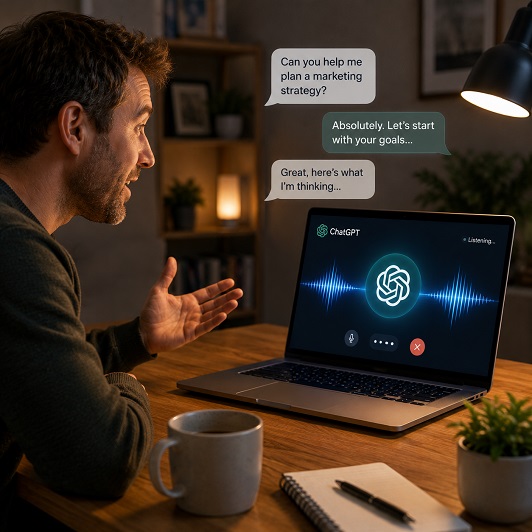
ChatGPT Learns To Talk Naturally
OpenAI has launched GPT-Live, a new voice system that allows ChatGPT to listen and speak at the same time, making conversations feel much more natural while laying the foundations for a future in which talking to AI could become more common than typing.
A New Way To Talk To AI
GPT-Live replaces the turn-based conversations used by previous versions of ChatGPT Voice with what OpenAI describes as a full-duplex architecture.
Previously, ChatGPT had to wait until a user stopped speaking before generating a response. That approach often resulted in awkward pauses, interruptions and conversations that felt less natural than speaking to another person.
GPT-Live changes that by continuously processing what it hears while simultaneously generating speech. This means users can interrupt the AI, pause to think, change direction mid-sentence or simply allow the conversation to flow more naturally.
As OpenAI explains: “GPT-Live is built on a full-duplex architecture, meaning it can listen and speak at the same time.”
Rather than waiting for silence before responding, the system can acknowledge what someone is saying with phrases such as “mhmm” or “got it”, wait patiently if the user pauses, or continue listening while deciding whether to respond.
Different Behind The Scenes
The second major change happens behind the scenes. Instead of trying to perform every task itself, GPT-Live separates conversation from more demanding work.
For example, when someone asks a question that requires web searches, deeper reasoning or more complex processing, GPT-Live quietly hands that task to another OpenAI model while continuing the conversation naturally. At launch, that background model is GPT-5.5, although OpenAI says it will automatically adopt newer frontier models as they become available. This means users can continue talking instead of waiting silently while the AI works through more demanding requests.
OpenAI believes this approach combines “frontier intelligence with natural interaction”, allowing increasingly capable AI to work in the background without interrupting the flow of conversation.
The result is intended to feel much more like a conversation between two people, where someone can continue talking while thinking through a more complicated answer.
More Than Just Voice
OpenAI says GPT-Live is its most capable voice model to date. In addition to more natural conversations, it can perform live translation, present visual information such as weather forecasts, sports scores and stock prices while speaking, and allow users to choose different levels of reasoning depending on how much thought they want ChatGPT to devote to a task.
The company also says GPT-Live performs significantly better than Advanced Voice Mode in evaluations measuring conversational flow, pleasantness, scientific reasoning and web search.
According to OpenAI, more than 150 million people already use ChatGPT’s Voice and Dictation features every week, suggesting voice interaction has already become a mainstream way of using AI for many people.
The company believes GPT-Live represents the next step in that evolution. As OpenAI explains: “We’re launching GPT-Live, a new generation of voice models that make talking with AI feel much more like having a real conversation.”
Safety Becomes Even More Important
Making AI conversations feel more human may also create some new challenges.
People naturally respond differently to spoken conversations than they do to typed text, particularly when an AI appears to listen attentively, acknowledge what someone is saying and respond with realistic timing.
OpenAI says GPT-Live includes dedicated safety training designed specifically for voice interactions, together with real-time safeguards that can steer conversations towards safer responses, provide support resources where appropriate or even end conversations in higher-risk situations.
The company has also introduced additional protections for younger users and says GPT-Live uses predefined voices rather than attempting to imitate real people.
As OpenAI notes: “GPT-Live is designed for conversation, not voice impersonation.”
Those safeguards are likely to become increasingly important as conversational AI becomes more convincing and people begin interacting with it for longer periods and on a wider range of personal and professional topics.
A Change In How We Use AI
Perhaps the most significant aspect of GPT-Live is what it suggests about the future of AI. Until now, typing has remained the primary way most people interact with advanced AI systems, with voice often viewed as a convenient extra.
GPT-Live appears to represent a move towards reversing that relationship, making spoken conversation the primary interface while increasingly complex reasoning happens invisibly in the background.
It also reflects a broader trend across the technology industry. Companies including Google, Amazon and Apple are all investing heavily in conversational AI assistants that feel less like software and more like collaborative partners capable of maintaining continuous, natural dialogue.
Competition is therefore shifting beyond which company has the smartest language model towards which can create the most intuitive and useful AI assistant.
What Does This Mean For Your Business?
For businesses, GPT-Live is another indication that conversational AI is evolving from a bit of a novelty into a practical workplace tool.
Natural voice interaction could make AI more accessible in situations where typing is inconvenient, including meetings, travel, customer support, engineering, field work and hands-free environments. It may also encourage wider adoption among employees who find voice more intuitive than traditional chatbot interfaces.
The wider implication, however, is that AI is steadily becoming less visible. Rather than asking staff to choose between different models or manually trigger searches, future systems are likely to decide automatically when to search the web, perform deeper reasoning or call specialist tools, all while maintaining a continuous conversation.
OpenAI’s launch of GPT-Live therefore represents much more than an improvement to ChatGPT’s voice. It signals a broader shift towards AI assistants that behave less like question-and-answer systems and more like intelligent collaborators, with natural conversation becoming the interface through which increasingly sophisticated artificial intelligence is delivered.