
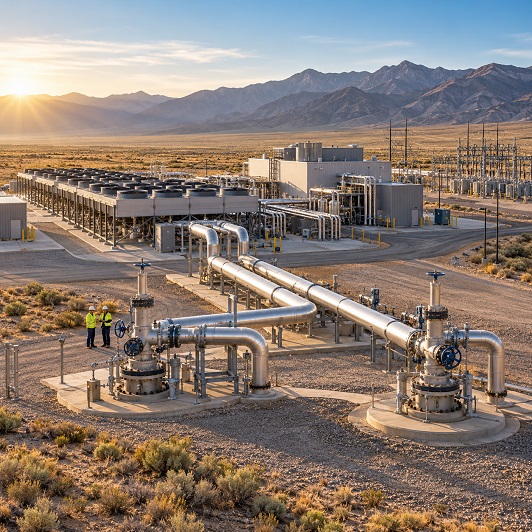
Geothermal Plant Delivers Power After 23-Month Build
Fervo Energy has begun commercial electricity generation at its Cape Station development in Utah, completing its first power facility in 23 months and demonstrating how underground heat could provide dependable renewable energy as demand for electricity grows.
GeoBlock
The first generating unit, which Fervo calls a GeoBlock, reached commercial operation on 30 September, one day ahead of its contractual deadline. It had connected to the grid six days earlier and achieved 33 megawatts of net output, meeting the production threshold required under its electricity supply agreement.
Commercial operation means the facility has moved beyond initial testing and is generating revenue under a power purchase agreement, a contract through which a buyer agrees to purchase electricity.
However, it seems this is just the first part of a larger development. Two further blocks are expected to bring Phase I to approximately 100 MW by January 2027, while an additional 400 MW is under construction for planned operation in 2028. Those later stages remain future commitments rather than electricity already available.
Why Is This A First?
Fervo describes Cape Station as the world’s first greenfield enhanced geothermal development to reach commercial operation under its supply contract, meaning a new facility built from scratch rather than an addition to an existing plant. The milestone builds on earlier work, including Fervo’s smaller Project Red, which has supplied electricity to the grid since 2023.
Cape Station takes that experience into a larger commercial development, showing how the technology could supply more electricity through purpose-built facilities. As chief executive Tim Latimer said in Fervo’s announcement, “No team has ever built a project like this anywhere in the world, and we did it ahead of schedule.”
How Does Enhanced Geothermal Work?
Conventional geothermal plants need underground hot water and rock that allows it to flow freely, which limits where they can be built. Fervo’s ‘enhanced’ approach makes more locations potentially suitable by using drilling techniques developed in the oil and gas industry, including drilling horizontally through hot rock and creating pathways for water to pass through.
Water is then pumped down into the rock, where it picks up heat before returning to the surface through separate wells. That heat is used to generate electricity, and the water is sent back underground to repeat the process, allowing the plant to draw energy from rock that would otherwise be difficult to use.
Why Does The Construction Time Matter?
Faster construction can obviously bring renewable electricity into service sooner and shorten the period during which developers spend money without earning revenue. Building in separate blocks also allows generation to begin while later sections remain under construction.
The 23-month figure needs some context, however, because it actually covers building and commissioning the first power facility. Cape Station’s exploration work began earlier, with Fervo announcing an exploration drilling groundbreaking in September 2023.
Fervo says it hopes to reduce future construction timelines to 18 months through repeated designs and lessons from earlier blocks. However, meeting that target will still depend on securing permissions, finding suitable underground conditions and connecting each plant to the electricity network, which Fervo acknowledges may lack the capacity needed to carry new power to customers.
Why Is This Important For Sustainability?
Geothermal’s main advantage is that underground heat is available through the night and during periods of low wind. Reliable generation from that resource could help electricity systems reduce dependence on fossil-fuelled plants when weather-dependent renewables produce less.
That is relevant to factories, hospitals and data centres, whose electricity needs continue outside sunny or windy periods. Geothermal could complement wind, solar and storage, making it easier to match cleaner generation with demand throughout the day.
However, low operational emissions don’t mean construction and operation have no environmental footprint. For example, drilling, steel, cement and equipment manufacturing require resources, while water use depends on the reservoir and cooling arrangements.
Pumping water underground can also cause movement in the surrounding rock and trigger earth tremors, so developers need to assess each site carefully and monitor conditions as they operate. The US Department of Energy has highlighted this risk, together with water use, as an environmental concern that geothermal projects must manage.
What Does This Mean For Your Business?
For UK businesses, Cape Station is evidence of some progress towards a broader supply of dependable renewable electricity, rather than an immediate offer of cheaper power. Its value will become clearer through sustained output, operating costs and successful delivery of later blocks, showing whether the approach can be repeated beyond an initial milestone.
When assessing electricity suppliers or data-centre sustainability claims, businesses should ask whether promised generation is operating, contracted or still proposed. They should also examine how supply matches demand over time, since buying enough renewable electricity across a year does not necessarily mean clean generation is available whenever operations need it.
The wider opportunity is to combine new energy sources with better use of existing resources. More dependable renewable generation could support electrification and reduce emissions, but efficiency remains valuable regardless of which technology supplies the grid. Businesses can prepare by understanding their demand, reducing waste and choosing energy arrangements supported by credible delivery evidence.