
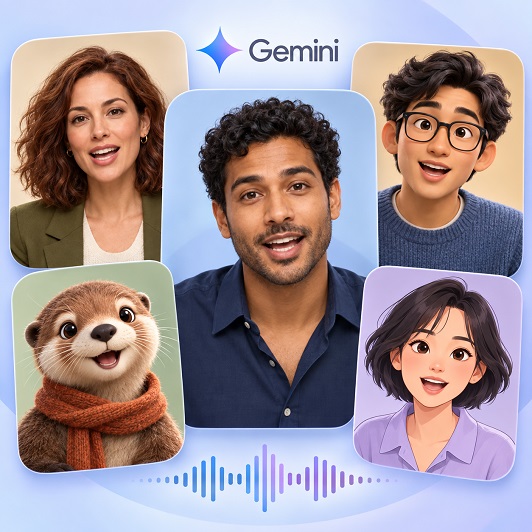
Google Gives Gemini A Human Face
Google has introduced animated and lifelike avatars for Gemini’s live conversations, giving businesses a way to put a talking face on AI services while raising questions about whether a more convincing appearance could encourage customers to trust answers they should question.
What Has Google Introduced?
Announced on 24 September, Gemini 3.8 Live with Live Avatar combines spoken AI responses with generated video, producing characters whose lips, expressions and head movements follow the conversation. Google says the feature is available through Gemini Enterprise, its business offering.
Google says the system can process visual and audio information together, allowing an avatar to respond to what it sees and hears. This makes it different from a pre-recorded presenter reading a fixed script, because its responses are generated during the interaction.
As Google explains, “Conversation is inherently multimodal: we listen, look, speak, and use facial expressions to communicate.” Its aim is to bring those different forms of communication into business AI services, including customer support and interactive guidance.
What Could Businesses Use It For?
A visual assistant could be used to guide someone through a process, answer questions or explain information without requiring them to navigate menus. On its blog, Google uses an imagined hotel check-in scenario, where conversation continues while the system works with other software, to demonstrate what the new feature’s capable of.
It relies on what Google calls “asynchronous tool calling”, meaning the agent can request information or trigger a connected software function in the background while continuing to speak. For example, it could check booking details without leaving the customer waiting through a silent pause.
That could make an interaction feel smoother, but the quality of the service will still depend on accurate information and appropriate permissions. It’s worth noting that a reassuring expression on the avatar may not mean that a reservation has been found correctly or that a requested change has actually been completed.
How Flexible Are The Avatars?
Businesses can choose from preset characters or, with approval, create a custom avatar from a reference image. Google says this can preserve a particular likeness, character identity or brand style, while noting that “Custom avatar creation is currently available only through enterprise allowlisting.”
In other words, organisations need permission to access that customisation capability, and it doesn’t mean that there’s unrestricted access for anyone to animate another person’s photograph.
Google also claims that it supports switching between 97 languages, with lip movements and expressions adapting during the conversation. Businesses serving international customers could find that really useful, although language support alone doesn’t necessarily mean equal accuracy across accents, specialist vocabulary or complicated requests.
Why Does A Human Face Matter?
People naturally use tone, expressions and conversational timing to judge whether somebody understands them. Google, therefore, seems to believe that reproducing those signals could make software easier to approach, as well as suggesting understanding, empathy or competence that the system has not demonstrated.
In fact, Google’s own researchers have examined this problem. A study involving focus groups with 30 technology professionals identified concerns that fluent, human-like behaviour could make errors harder to notice and encourage excessive trust.
That research explored workers’ experiences and concerns, rather than measuring harm caused by Live Avatar. Even so, it raises a relevant question for deployment, because improving how convincingly an answer is delivered does not necessarily improve the answer itself.
What Safeguards Are There?
Google says, “We built Live Avatar with strict safeguards designed to respect identity, and keep AI-generated content transparent.” Its announcement highlights SynthID, a watermarking technology embedded in generated audio and video.
Also, because the watermark is imperceptible, it can help identify synthetic content through detection tools without necessarily alerting somebody during a conversation. Businesses should therefore distinguish between making content detectable afterwards and making the nature of the interaction obvious from the start.
However, it should be noted that clear disclosure also can’t remove every risk. For example, someone may know they are speaking to AI yet still place too much confidence in a calm, convincing response, particularly when the character appears knowledgeable or sympathetic.
What Are The Current Limits?
Google’s model card says Live Avatar supports a few minutes of continuous interaction rather than extended hours. It also acknowledges that the underlying models can produce hallucinations, meaning incorrect or invented information, and may experience delays or timeouts.
These limitations matter when deciding whether the technology suits a brief reception enquiry or a longer, more complicated support conversation. Businesses need to assess the whole interaction, including what happens when the avatar cannot complete the task.
What Does This Mean For Your Business?
For businesses considering an avatar, the starting point should be a service problem it could help solve. A limited trial could compare it with existing text or voice support, measuring successful outcomes, customer understanding and the effort needed to correct mistakes.
Also, customers should know they are dealing with AI, as well as being provided with an obvious route to a person. Organisations also need rules covering what the agent can access, which actions require confirmation and how conversation data is handled, particularly where cameras and microphones capture personal information.
The strongest business case will come from making a service easier to use without encouraging misplaced confidence. A friendly digital face may attract attention, but lasting trust will depend on accurate answers, dependable actions and a business taking responsibility when something goes wrong.