
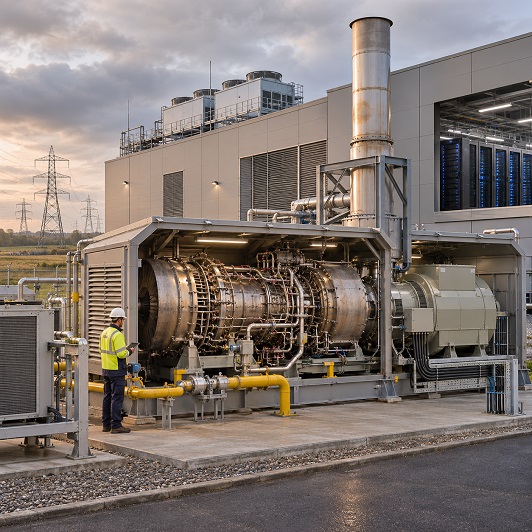
Old Jet Engines Power Data Centres Waiting For Electricity
Data centre developers are turning retired aircraft engines into gas-fired generators to get facilities running sooner, raising questions about the environmental cost of expanding AI infrastructure faster than electricity networks can support it.
Why Are Developers Looking For Alternatives?
A completed data centre can’t start serving customers without a dependable electricity supply, and securing one can take considerably longer than constructing the building. In fact, the International Energy Agency says new grid infrastructure can take five to 15 years to develop, compared with one to three years for a data centre.
For example, in northern Virginia, a major US data centre hub, connection waits can reach seven years. Not surprisingly, developers facing that kind of delay have a strong commercial incentive to generate electricity themselves, particularly when expensive servers and customer contracts depend on getting facilities operational. However, growing demand for conventional gas turbines has also put pressure on equipment supplies, making refurbished aircraft engines more attractive.
How Can An Aircraft Engine Power A Data Centre?
Aircraft engines have been adapted to generate electricity for years, but the growth of AI is creating demand for them to power entire data centres while operators wait for a grid connection.
ProEnergy’s PE6000, for example, uses the refurbished core of a General Electric CF6-80C2 engine, a type used in aircraft including the Boeing 747. The company adapts it to burn natural gas instead of aviation fuel and connects it to a generator that turns the engine’s mechanical power into electricity.
Cooling equipment, controls and exhaust treatment complete the installation, allowing an engine originally built for flight to become part of a power plant on the ground.
Who’s Buying The Equipment?
In April, US power equipment and services company ProEnergy announced that AI infrastructure developer Crusoe had ordered 13 of its PE6000 generators. Each can produce 50 megawatts, giving them a combined generating capacity of 650 megawatts, although actual output will depend on how they are operated.
Crusoe’s senior vice-president for power infrastructure, John Adams, explained the reason for the purchase, calling it “a strategic move to rapidly provide the energy capacity our hyperscale projects require”. The announcement didn’t specify where every generator would be installed, and ordering the equipment is only part of getting a site ready. Developers still need to arrange fuel supplies, secure the necessary permits and complete installation before electricity can be generated.
Does Reusing Engines Make This Sustainable?
Refurbishing an aircraft engine makes further use of materials and components that already exist, reducing the need to manufacture replacements. However, the engine will still burn fuel throughout its working life, so the benefits of reuse need to be considered together with the emissions it produces.
ProEnergy says its pollution-control systems can reduce nitrogen oxides by 90 per cent and carbon monoxide by more than 95 per cent. These reductions could help protect local air quality, but they don’t mean the equipment produces correspondingly less carbon dioxide.
How clean the electricity is will therefore depend on how much fuel the generators use, how often they run and what other power sources are available. An engine used briefly while a cleaner supply is connected presents a different sustainability question from one supplying a data centre continuously for years.
Why Are Local Communities Concerned?
People living near these developments may experience the effects long before a permanent electricity supply arrives. For example, turbines operating beside a data centre can create noise and release air pollutants, making the choice of power source a concern for neighbouring communities as well as the operator.
Those concerns have prompted disputes around AI facilities in the Memphis area. Back in July, the operator announced that it had agreed a timetable with Mississippi’s environmental regulator to remove 69 temporary mobile turbines by July 2027. Their removal is due to take place as a permanent gas-fired power plant comes into service.
In this case, replacing temporary turbines will therefore still leave the facilities relying on gas. For residents and customers assessing environmental promises, it matters what replaces the equipment, rather than simply whether it is removed.
How Is This Affecting Data Centre Growth?
Power shortages are already threatening development schedules. The IEA estimates that around 20 per cent of planned data centre projects could face delays unless electricity constraints are addressed. Generating power on site can help developers start operating sooner, but they must still secure fuel supplies and permission to run the equipment.
Public opposition can also make expansion more difficult. For example, on 6 November, protesters entered a Microsoft data centre construction site in Amsterdam during wider European demonstrations. Although this was separate from the converted-engine projects, it shows why securing electricity is not the only challenge. Developers also need to address local concerns about the facilities they want to build.
What Does This Mean For Your Business?
For UK businesses buying cloud or AI services, this is a reason to look beyond a supplier’s overall renewable-energy commitments and ask how the data centres serving them are powered. Those commitments may not explain whether a particular facility uses gas generators or how long it expects to need them.
A useful answer should include information about fuel use and emissions, together with a timetable for moving to another supply. Businesses should also ask what would happen if that connection were delayed again. A longer period of gas generation could affect the supplier’s environmental commitments and operating costs.
Converted aircraft engines can help providers bring new services online sooner, but customers need to understand the longer-term consequences. The important question is whether there is a realistic, funded plan for cleaner electricity, with progress that can be checked, or whether temporary generators could become a lasting part of the service’s energy supply.