
Pentagon Plans New Command For Autonomous Warfare
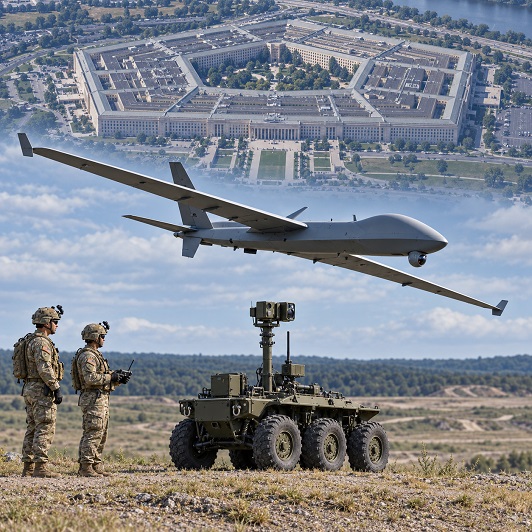
The US military plans to create a command dedicated to drones, robots and autonomous systems, aiming to get technology into service faster while raising questions about funding, reliability and responsibility when machines take on more military tasks.
AutoWarCom Announced
US Defence Secretary Pete Hegseth announced plans for Autonomous Warfare Command, or AutoWarCom, during his State of the Force address at Marine Corps Base Quantico on 30 September. Led by a four-star officer, it would support all military branches and have powers similar to those of the armed services, giving it a direct role in developing autonomous technology and getting it into use.
The Pentagon aims to establish the command by 1 October 2027 and is working with Congress on the necessary arrangements. However, its leader has yet to be named and its detailed structure is still being decided, so it remains a planned command rather than an operational one.
Why Create A Separate Command?
The Pentagon wants to get drones and other autonomous systems into service faster, arguing that its existing purchasing and development processes struggle to keep pace with the technology. It’s thought that bringing this work under one command could help the military branches coordinate their efforts, supported by new specialist roles for personnel operating and maintaining the equipment.
However, the proposal is also possibly about influence over military spending. For example, a dedicated command could give autonomous systems stronger backing when competing for money with established aircraft, ships and other programmes. Seen this way, AutoWarCom may be an attempt to change the Pentagon’s priorities as much as its technology, although that will depend on how much authority and funding it actually receives.
It’s also worth noting here that there seems to be a bit of a contradiction in creating another headquarters while promising to reduce bureaucracy. Some critics have questioned whether the officers, civilian staff and management structures needed for AutoWarCom could add costs and complicate decisions rather than speed them up. The test will be whether it helps troops receive reliable equipment sooner, rather than giving existing programmes another chain of approval to navigate.
What Is Project Agincourt?
To begin that work before the command exists, the Pentagon is launching Project Agincourt through its existing office overseeing unmanned systems. It will continue current work while testing a different approach to acquiring equipment and preparing the command’s foundations.
The intention seems to be to bring military users and technology developers closer together, so experience from operations can influence improvements more quickly. Giving those using the equipment a stronger voice could help avoid purchasing systems that perform well in demonstrations but prove difficult to maintain or adapt.
However, speed will depend on whether responsibilities, funding and standards are clear. Creating another organisation will only help if it removes delays rather than adding another approval stage.
How Does Project Meridian Fit In?
While AutoWarCom is intended to get autonomous systems into military use faster, Project Meridian will examine what equipment and technologies future conflicts might require. The Pentagon has commissioned MITRE, a not-for-profit research organisation, to lead the study, drawing on expertise from technology, business and national security.
Its remit reaches beyond drones to AI, robotics, biotechnology and directed energy, which includes technologies such as lasers. The commissioning memorandum calls for researchers to identify “critical capability gaps” and propose “actionable solutions”, with recommendations due by 28 January 2027.
That could help the Pentagon look beyond the equipment it already buys, but forecasting future warfare inevitably involves some uncertainty. The value of the study will depend on whether it explains which ideas deserve testing, what they could realistically achieve and where the risks lie, rather than simply producing a list of ambitious technologies.
Meridian’s recommendations could therefore influence future investment, while Project Agincourt tackles the more immediate work of preparing the new command. Keeping those roles clear matters, because identifying a promising technology does not establish that it is reliable, affordable or ready for military use.
What About Funding And Human Control?
The scale of the Pentagon’s ambition is reflected in its request for approximately US$54.6 billion for the existing Defense Autonomous Warfare Group in fiscal year 2027, compared with around US$226 million for 2026. However, that request still depends on Congress and should not be confused with an approved budget for AutoWarCom.
Even if the funding is secured, deploying more autonomous equipment will require clear decisions about what each system can do and when people must intervene. A machine might navigate or carry out surveillance without constant instructions, but that doesn’t necessarily mean it can independently select and attack targets.
The Pentagon’s published weapons policy requires systems to allow “appropriate levels of human judgment over the use of force”, supported by testing and operator training. Putting that into practice means checking how equipment behaves when conditions change or an enemy interferes with it, so the push to deploy systems faster must still leave time to establish whether they can be used reliably and responsibly.
What Does This Mean For Your Business?
For technology suppliers, the plans suggest potential demand extending beyond drones to communications, sensors, software, maintenance and cybersecurity. However, businesses should distinguish announced ambitions from funded contracts before committing resources. Understanding purchasing routes, security requirements and how products connect with existing systems will matter more than assuming a large headline budget guarantees orders.
For organisations introducing civilian robotics or autonomous software, the practical lesson is that equipment needs people and processes around it. A trial should establish who authorises actions, who monitors performance and what happens when communications fail or results become unreliable. Staff also need time and training to recognise when the technology has reached its limits.
The wider significance is that autonomy is becoming an organisational commitment rather than an isolated experiment. Its value will depend on whether systems can be supported, updated and controlled throughout their working lives, making clear responsibility and evidence from realistic testing as important as the capabilities demonstrated at launch.