
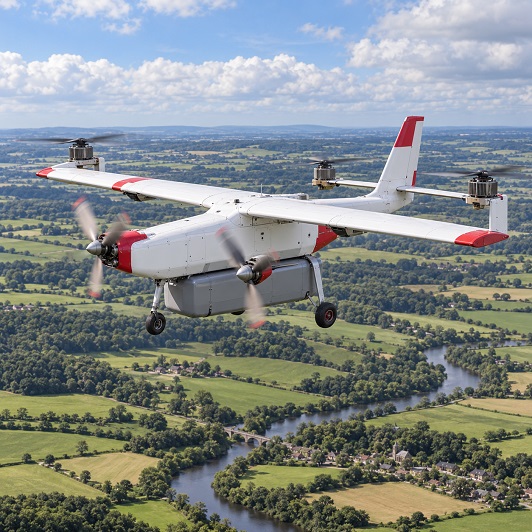
Pilotless Cargo Aircraft Takes Flight
A cargo aircraft has completed a week of flights without anyone on board from a working Louisiana airport, demonstrating how autonomous deliveries could become part of everyday aviation while highlighting the regulatory and commercial work still ahead.
What Happened?
California-based Elroy Air announced on 2 September that its Chaparral aircraft had completed the first autonomous, uncrewed flights authorised under the US Department of Transportation and Federal Aviation Administration’s eVTOL Integration Pilot Program, known as eIPP.
The flights took place in late August at Houma-Terrebonne Airport, in partnership with helicopter operator Bristow Group and LIFTOff Louisiana. Cargo included medical supplies, parcels, spare parts, food and water, representing the practical loads that businesses and emergency services might eventually transport.
The significance was essentially the operating environment. As Elroy Air chief executive Dr Andrew Clare explained: “Over the course of the week, Chaparral flew autonomously and with no pilot on board from one of the nation’s busiest airports for rotorcraft under Air Traffic Control oversight.”
More Than A Delivery Drone
Moving cargo without a pilot is a different kind of challenge when the aircraft must operate from an airport used by other traffic. The Houma flights therefore tested more than whether a drone could carry supplies, providing evidence to help regulators understand how automated aircraft could fit into established aviation procedures.
Chaparral takes off vertically before flying forwards on its wings, combining access to sites without runways with the ability to cover longer distances. Its hybrid-electric system uses fuel, so these flights should not be mistaken for a demonstration of entirely battery-powered or emissions-free transport.
Elroy puts its carrying capacity at more than 227kg, placing it in a category suited to industrial supplies rather than individual takeaway orders. It now remains to be seen whether aircraft of this kind can move those loads reliably and economically under the conditions that everyday freight services face.
Why Did The FAA Allow It?
The US government’s Federal Aviation Administration (FAA) authorised the demonstrations through a programme designed to gather operational evidence about integrating advanced aircraft into American airspace. Established following the “Unleashing American Drone Dominance” executive order, eIPP brings manufacturers, operators and public authorities together to test how that integration could work.
Back in March, eight projects across 26 states were selected, and the FAA says findings will help identify gaps and improve procedures, with Louisiana providing a setting where aviation already supports offshore industries.
As FAA administrator Bryan Bedford explained: “These test flights demonstrate how these new aircraft can expand cargo delivery options to communities nationwide and improve our logistics infrastructure.”
However, thankfully, the programme doesn’t bypass certification requirements. The FAA says participating aircraft must already be going through its formal type certification process, so successful demonstrations should not be confused with unrestricted permission to launch commercial services.
Does Pilotless Mean Nobody Is In Control?
Although these have been described by Elroy as autonomous flights, the FAA’s announcement refers to remotely piloted aircraft and calls Chaparral highly automated. In short, this means that nobody was on board, and the flights were conducted under air traffic control oversight.
However, it’s not clear from Elroy’s announcements whether humans had a supervisory role, what the intervention arrangements were, how communications failures were handled or which precise operating restrictions applied during the demonstrations.
Useful For Cargo
It’s worth noting here that Louisiana’s offshore energy industry provides a practical setting for these trials, because operators regularly transport tools, spare parts and other supplies to installations at sea. This is why Bristow, which already serves that market with helicopters, is participating to explore whether uncrewed aircraft could take on some of those journeys.
That gives the testing a commercial purpose beyond demonstrating autonomous flight. For customers, the value would depend on whether supplies could arrive reliably and at a competitive cost, particularly when an urgently needed component is holding up work.
Uber And Zipline
Similar commercial ambitions are driving Uber’s recently announced partnership with Zipline, which targets one million drone deliveries a day by the end of 2029. Although those deliveries involve much smaller loads, both projects face the task of turning automated flights into dependable services that businesses and customers can use routinely.
What Still Needs Proving?
Elroy’s military work provides another possible development route, including a recently announced US$46 million Army contract. Meanwhile, manufacturing partner Kratos plans to produce the first production Chaparral aircraft in late 2026.
That said, neither development guarantees commercial adoption. Elroy says potential customers have expressed interest in more than 1,400 aircraft, but they have not committed to buying them, so there is no guarantee those sales will happen.
What Does This Mean For Your Business?
For UK businesses, the immediate significance is evidence that autonomous freight is being tested within existing aviation operations. The US trial does not itself authorise equivalent services in Britain, but it offers a useful indication of where logistics suppliers may invest next.
Organisations moving urgent parts, medical supplies or freight to difficult locations could eventually gain more delivery options. Before relying on them, procurement teams would need evidence of approved routes, reliable performance, insurance, weather limitations and a workable fallback when flights cannot operate.
The practical opportunity is faster access to essential supplies where existing transport struggles. Houma moves that possibility forward, while leaving routine reliability and commercial value to be demonstrated.