
Solar Ambulance Passes Kenya Test
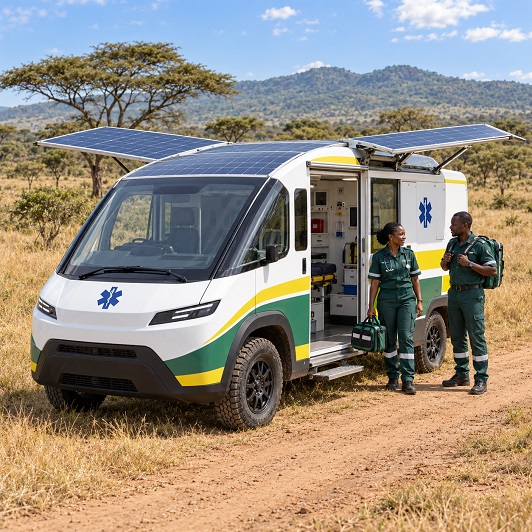
A solar-powered mobile clinic (ambulance) developed by Dutch students has completed more than 800km of testing in Kenya, demonstrating how sunlight could power both the journey to remote communities and the medical equipment needed when it arrives.
Taking Healthcare To The Patient
For communities far from a hospital, reaching medical care can mean travelling for hours over difficult roads. Even arriving at a local clinic may not guarantee access to diagnostic equipment if the building has no reliable electricity.
Stella Juva was designed around those connected problems. Built by 23 students from Solar Team Eindhoven, working with Amref Health Africa, the vehicle carries equipment including an X-ray machine, ultrasound scanner, defibrillator and refrigeration for vaccines.
Although its developers describe it as the world’s first solar ambulance, it works more like a travelling clinic. Its purpose is to bring health workers, equipment and electricity to patients, rather than primarily carrying patients to hospital.
Tested In Kenya
By way of testing, during August this year, the team drove the mobile clinic / ambulance named ‘Stella Juva’ more than 800km through Kenya, including a six-hour journey over difficult roads to Mosiro, where the local health clinic has no electricity. Reaching places like this was central to the trial, which tested whether the vehicle could both withstand the journey and provide the power needed to make medical equipment useful on arrival.
According to the developers, the vehicle completed the route with relatively few problems, although a broken steering rod needed replacing, a repair that took half an hour. Once parked for medical testing with Amref, it generated more solar electricity than it consumed while all its onboard medical equipment was being used simultaneously.
For the team, that result seems to have demonstrated the potential to bring working diagnostic equipment to communities where a lack of power limits the care available. For example, team manager Mathijs van Gerven described the achievement as being able “to drive sustainably, but also to be able to provide fully independent care”, adding: “Especially in remote areas where energy is often scarce, this can make all the difference.”
How Sunlight Powers The Clinic
In terms of how the solar power for the vehicle works, panels on the roof collect energy while Stella Juva travels, with additional panels extending from its sides when parked. A battery stores electricity for use when sunlight is limited.
The arrangement gives parked time a practical purpose. For example, while health workers carry out examinations, the larger solar collection area can supply equipment and replenish stored energy, reducing dependence on a charging point or fuel delivery.
However, the reported electricity surplus applies to stationary medical testing. It should not be read as proof that the vehicle produces surplus energy throughout every journey or can maintain the same schedule regardless of weather, distance and demand.
Why This Matters For Healthcare
Reliable electricity is essential for refrigeration, diagnosis and many routine procedures, yet a 2023 report from WHO and partner organisations estimated that close to one billion people in low- and lower-middle-income countries were served by facilities with unreliable electricity or none at all.
For pregnant women, the consequences can include missing opportunities to identify complications early. Amref’s maternal and child health project lead Geoffrey Sadera explained in the team’s announcement: “In Narok, long distances and unreliable electricity still make quality healthcare difficult to access.”
Sadera suggested that one outreach visit could allow 30 to 40 pregnant women to receive ultrasound examinations within their own community. That illustrates the intended benefit, although no real patients were examined during this trial.
The estimate that approximately 200 people could have received care over two days was similarly a projection from the testing, rather than a count of patients treated.
Where The Environmental Benefit Comes From
Using sunlight for transport and medical equipment could reduce reliance on petrol or diesel vehicles and generators. Bringing services closer to communities could also reduce some patient journeys, although the project has not published a measured carbon saving.
It should be noted here that solar-powered healthcare itself isn’t new. For example, UNICEF supports solar refrigeration that keeps vaccines cold without a grid connection, while WHO identifies solar panels and battery storage as options for improving healthcare resilience and reducing polluting emissions.
What’s different about Stella Juva is that it combines those energy benefits with mobility. That said, its environmental performance over its lifetime will likely still depend on manufacturing, battery production, maintenance and how much conventional transport or generator use it replaces.
What Happens After The Trial?
The prototype is returning to the Netherlands, with the students seeking partners to explore further development. Turning it into a dependable service will require funding, trained staff, spare parts and arrangements for maintaining both the vehicle and its medical equipment.
Amref programme manager John Kutna said: “The solar ambulance would be quite useful in these locations.” Establishing how to provide that usefulness affordably and consistently is the next task.
What Does This Mean For Your Business?
For businesses considering sustainability investments, Stella Juva offers an example of renewable energy addressing an operational problem as well as emissions. Generating power where work happens can make services possible in places where fuel supplies or electricity connections are difficult to secure.
The useful part of the exercise is really the ability to assess energy, transport and service delivery together. Investment decisions still need realistic running costs and maintenance plans, but this trial shows why the value of cleaner technology can extend beyond energy savings to the services it enables.
There is also a question of where each pound invested delivers the greatest benefit. A mobile solar clinic could make sense for scattered communities, while a busy permanent clinic might benefit more from its own solar panels and battery storage. Businesses face similar choices, making it important to compare a new solution with simpler alternatives and judge success by the reliability, reach and quality of the service it supports.