
Drilling Deeper For Clean Energy
A US clean energy company has raised $134 million to build what it says will be the world’s first commercial superhot geothermal power plant, using microwave technology to reach temperatures far beyond those accessible with conventional drilling in a development that could dramatically expand the role of geothermal energy in a low-carbon future.
A New Generation Of Geothermal Energy
US-based Quaise Energy, headquartered in Houston, has announced the first close of a $134 million Series B funding round, bringing its total funding to $230 million.
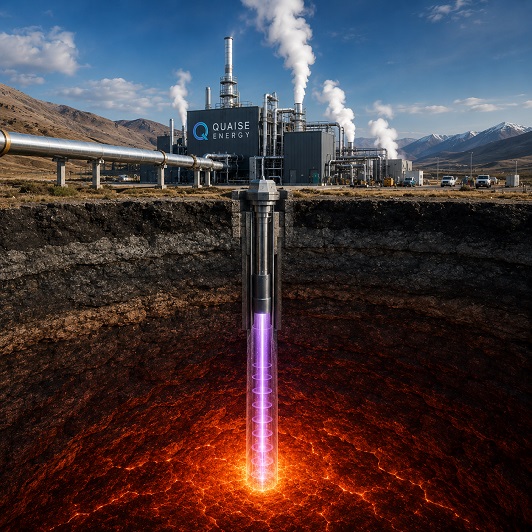
The investment will finance Project Obsidian in Central Oregon, which the company says will become the world’s first commercial superhot geothermal power plant while also supporting the continued development of its millimetre-wave drilling technology.
Unlike conventional geothermal projects, which rely on naturally accessible underground heat, Quaise aims to drill much deeper to reach rock temperatures between 300°C and 500°C. At those temperatures, significantly more energy can be extracted from each well, potentially allowing geothermal power to compete directly with fossil fuels and nuclear power while producing virtually no carbon emissions during operation.
As Carlos Araque, Chief Executive Officer and President of Quaise Energy, explains: “Our ambition is to power civilization with Earth’s most compelling energy source. This round takes us from field-proven technology to first commercial revenues.”
Replacing Drill Bits With Microwaves
The key innovation lies in how Quaise plans to reach those extreme depths. For example, conventional drilling becomes increasingly difficult as rock gets hotter and harder because drill bits wear out rapidly, making deep geothermal wells expensive and technically challenging.
Quaise’s solution, developed following more than a decade of research at the Massachusetts Institute of Technology (MIT), replaces conventional drill bits beyond certain depths with high-power millimetre-wave beams that effectively vaporise the rock instead of mechanically cutting through it.
The company has already demonstrated the technology under real field conditions, drilling more than 100 metres through granite during 2025. It is now approaching one kilometre in depth at its Central Texas test site, which would represent the deepest penetration ever achieved using millimetre-wave drilling and the deepest recorded by any non-contact drilling technology.
The next challenge is considerably greater. Quaise ultimately aims to drill beyond five kilometres, where temperatures become high enough to unlock the enormous energy potential of superhot geothermal systems.
Why Hotter Really Matters
Traditional geothermal power stations are geographically limited because commercially useful underground heat is only accessible in certain locations. Superhot geothermal could change that.
By drilling much deeper, Quaise believes temperatures of between 300°C and 500°C become accessible across far larger areas of the world, allowing clean, continuous electricity generation in places that would previously have been unsuitable for geothermal energy.
The company says its technology has “the unique potential to reach rock at temperatures of 300-500°C in most places worldwide, enabling the construction of geothermal systems that rival fossil and nuclear energy in power density and renewables in cost.”
Unlike solar and wind power, geothermal energy is also available around the clock, regardless of weather conditions or the time of day. That makes it particularly valuable as countries attempt to decarbonise electricity systems while maintaining reliable supplies.
Meeting Growing Demand For Clean Electricity
The timing of the announcement reflects another important trend. Electricity demand is rising rapidly as transport, heating and industry become increasingly electrified, while artificial intelligence data centres are adding substantial new demand to national grids.
Meeting that growth sustainably will require much more than simply installing additional renewable generation. Power systems also need dependable low-carbon sources capable of operating continuously to complement intermittent renewable energy.
Quaise believes superhot geothermal could become one of those technologies. With this in mind, construction has already begun on Project Obsidian, which is being built on federal geothermal leases in Oregon’s Deschutes National Forest. The company says the project has gigawatt-scale potential and aims to deliver its first electricity to the grid by 2030.
An Important Reality Check
Despite the enthusiasm surrounding the funding, considerable engineering challenges remain before the technology can be deployed commercially.
Although the drilling system has demonstrated encouraging progress, it has yet to reach the depths required for commercial superhot geothermal production. Project Obsidian itself also remains under development, meaning the commercial viability of the approach has not yet been proven.
The latest investment therefore represents confidence in the technology rather than confirmation that every technical challenge has already been overcome.
Even Quaise’s announcement focuses on the transition still ahead, describing the funding as the point where the company moves “from field-proven technology to first commercial revenues.”
What Does This Mean For Your Business?
For businesses pursuing sustainability goals, developments like Quaise’s highlight how the clean energy transition is broadening beyond familiar technologies such as wind and solar.
Reliable, zero-carbon electricity available around the clock could eventually help reduce dependence on fossil fuels while providing the stable energy supplies needed for manufacturing, digital infrastructure, transport and increasingly energy-intensive technologies such as AI.
Although commercial superhot geothermal remains several years away, the direction of travel is becoming clearer. Businesses developing long-term sustainability strategies are likely to benefit from monitoring emerging technologies capable of delivering dependable clean power alongside renewables rather than viewing decarbonisation solely through the lens of today’s energy mix.
Quaise’s ambitious drilling technology still has significant engineering hurdles to overcome, but if it succeeds, it could unlock one of the world’s largest untapped sources of clean energy. Rather than relying only on the sun above or the wind around us, future low-carbon electricity systems may increasingly draw on the immense heat that has always existed beneath our feet.