
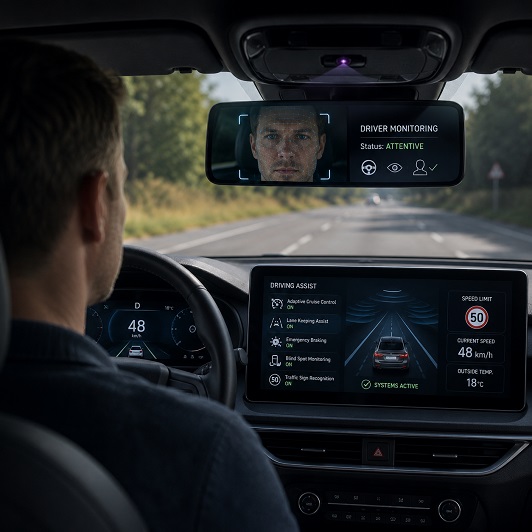
Every New EU Car Must Now Watch The Driver
From 7 July 2026, every newly manufactured passenger car and van sold in the European Union must include a new generation of advanced safety systems, including technology that monitors whether drivers are paying attention to the road, marking another significant step towards vehicles that actively watch over both their occupants and everyone around them.
The Next Stage Of Smarter Vehicle Safety
The changes form part of the second phase of the EU’s General Safety Regulation, which has gradually introduced advanced driver assistance systems as mandatory equipment rather than optional extras.
The first phase, which took effect in 2024, introduced technologies such as intelligent speed assistance, lane-keeping systems, reversing detection and driver drowsiness warnings.
This latest phase goes further by requiring all newly manufactured passenger cars and vans to include advanced emergency braking capable of detecting pedestrians and cyclists, a driver distraction warning system, improved forward vision, new tyre performance tests and a larger area of safety glass designed to offer greater protection for pedestrians.
The European Commission says these new requirements are intended to make “safer cars, safer roads” while helping protect “pedestrians and cyclists, address crashes caused by driver distraction, and encourage widespread adoption of advanced driver-assistance systems.”
The Camera Watching The Driver
Perhaps the most talked-about feature is the new driver distraction warning system.
Unlike traditional driver assistance features that monitor the road ahead, this system uses a cabin-facing camera to observe the driver’s head position and gaze direction. If it determines that the driver’s attention has wandered away from the road for too long, it provides a warning encouraging them to refocus.
The technology is designed to reduce one of the biggest causes of road accidents, namely driver distraction.
Importantly, this is not an autonomous driving system. The driver remains fully responsible for controlling the vehicle at all times. Instead, the technology acts as another safety aid, much like automatic emergency braking or lane departure warnings.
Even so, the requirement has generated debate among privacy campaigners, who question the increasing use of cameras inside vehicle cabins, even where the systems are designed to analyse attention in real time rather than permanently record drivers.
Building Towards More Automated Vehicles
Although the regulation is focused on improving safety rather than introducing self-driving cars, it also reflects a much broader change taking place across the automotive industry.
Modern vehicles increasingly rely on cameras, radar, sensors and powerful onboard computers to assist drivers with everyday tasks. As more of this technology becomes mandatory, every new vehicle effectively gains much of the hardware needed to support increasingly advanced driving functions in the future.
Although the distinction is important, it’s worth noting that these are still driver assistance systems rather than autonomous vehicles. That means they’re really just designed to support a human driver, who remains responsible for the vehicle, rather than making driving decisions independently.
However, the same sensors and processing power that help detect pedestrians or monitor driver attention today are likely to form part of the foundation for more advanced automated driving capabilities tomorrow.
Part Of Vision Zero
The regulation forms part of the European Union’s long-term Vision Zero strategy, which aims to reduce road deaths and serious injuries to as close to zero as possible by 2050.
While European roads are already among the safest in the world, thousands of people continue to die or suffer serious injuries every year in road accidents.
The European Commission believes expanding the use of advanced safety technology across every new vehicle will make a significant contribution towards reducing those numbers.
As the Commission explains: “Manufacturers were given more time to develop these more technically demanding features, which is why the legislation was rolled out in multiple phases.”
What Does This Mean For Your Business?
For businesses operating company cars or commercial vehicle fleets, these technologies will increasingly become standard equipment rather than expensive optional extras.
Over time, that could help reduce accidents involving distracted driving while improving protection for pedestrians and cyclists, potentially lowering repair costs, insurance claims and vehicle downtime.
The wider significance extends beyond road safety. The regulation demonstrates how software, cameras and artificial intelligence are becoming fundamental components of modern vehicles rather than premium add-ons. Cars are steadily evolving into sophisticated computing platforms that continuously monitor both their surroundings and, increasingly, the behaviour of their drivers.
For organisations purchasing vehicles over the coming years, the conversation is therefore likely to become less about choosing advanced safety technology and more about understanding how increasingly intelligent vehicles fit within wider policies covering driver training, fleet management, privacy and data governance. The move towards smarter vehicles is no longer optional and is becoming the new baseline for road transport across Europe.