
3D-Printed Battery Could Speed Up Net Zero
Researchers at Queen’s University Belfast have developed a low-cost 3D-printed battery that could help overcome one of renewable energy’s biggest obstacles by making long-duration electricity storage cheaper, more reliable and easier to research, potentially accelerating the transition away from fossil fuels.
What Problem Are Researchers Trying To Solve?
Renewable energy generation continues to expand rapidly around the world, yet one major challenge remains unresolved. Wind turbines only generate electricity when the wind blows, while solar panels stop producing power overnight or during periods of poor weather.
That means electricity generated from renewable sources must be stored efficiently so it can be used whenever demand requires it. Without reliable energy storage, electricity grids continue to rely on fossil-fuel power stations to bridge the gaps when renewable generation falls.
As Dr Hugh O’Connor from Queen’s University Belfast explains: “Tackling climate change is widely recognised as one of the major challenges facing modern society.”
He also points out: “The biggest challenge with renewable energy is simple – we cannot control when the sun shines or when the wind blows. The uncomfortable reality is that clean energy still only makes up a small share of our overall energy use – around just 16 per cent in both the UK and Ireland.”
The research team believes solving the storage challenge is essential if renewable energy is to replace fossil fuels on a much larger scale.
Why Flow Batteries Matter
Much of today’s attention seems to be focused on lithium-ion batteries, which already power smartphones, laptops and electric vehicles. Although highly effective for many applications, they become increasingly expensive for storing very large amounts of electricity over long periods.
Unlike lithium-ion batteries, which store energy within solid electrodes, flow batteries store it in liquid electrolytes held in external tanks. This makes them particularly well suited to grid-scale energy storage, where large amounts of renewable electricity may need to be stored for many hours before being released.
Most commercial flow batteries currently rely on vanadium, a metal that is produced in relatively few parts of the world and whose price can fluctuate significantly. Queen’s researchers have instead developed a battery based on iron, which is far more readily available and considerably less vulnerable to supply constraints.
The team also points out that flow batteries use safer aqueous chemistry than lithium-ion systems while avoiding the ethical concerns associated with cobalt mining that has historically been linked with many lithium-ion batteries.
A Battery That Costs A Fraction Of The Price
The breakthrough began during Dr O’Connor’s PhD research when he discovered that purchasing a laboratory flow battery cell could cost between £2,000 and £3,000.
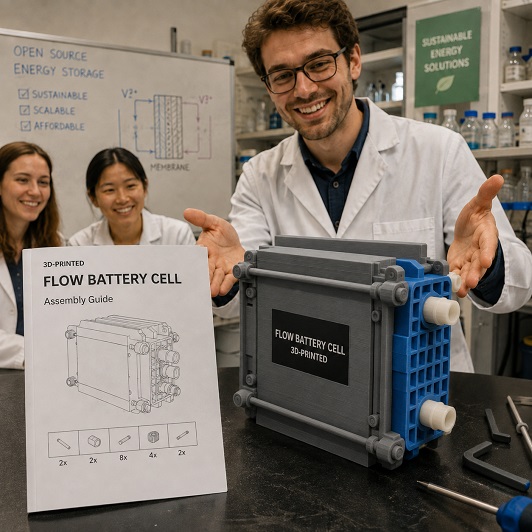
Rather than accepting that cost, he began designing and manufacturing his own using 3D printing.
Describing the project, Dr O’Connor said: “As part of my PhD research, I realised how expensive it was to buy a flow battery cell – anything up to £3,000 – so I started 3D-printing them. After a lot of trial and error, eventually these started to work really well and I was able to create one for around £75.”
Reducing the cost of individual research cells makes advanced battery research accessible to many more laboratories while allowing researchers to test new battery chemistries much more affordably.
Why Standardisation Could Be The Bigger Breakthrough
Perhaps the most significant achievement is not the battery itself but the way the researchers have chosen to share it. For example, Dr O’Connor discovered that laboratories around the world were often obtaining different experimental results simply because they were using different battery designs and testing methods. That inconsistency made it difficult to compare findings or build confidently on each other’s work.
He explained: “For research to move forward, the way we use flow batteries needs to be standardised.”
Instead of commercialising the design, the Queen’s team produced what Dr O’Connor describes as an “Ikea-style” instruction manual and distributed both the battery design and assembly guidance to research groups worldwide.
The initiative has already brought together more than 35 research groups, including teams from the Massachusetts Institute of Technology (MIT), Harvard University and the University of Cambridge, all using identical battery cells and testing protocols.
Dr Josh Bailey, a fellow researcher at Queen’s University Belfast, said: “It’s been fantastic to see that we’re already making global impact. By distributing the Queen’s cell around the world, we have been able to lead a large, international research study.”
He added that the collaboration is “helping to accelerate breakthroughs in long-duration energy storage, advance the transition away from fossil fuels, and firmly position our team at Queen’s as leading the development of clean, reliable energy technologies.”
What Does This Mean For Your Business?
For businesses, the research highlights that long-duration energy storage is becoming one of the most commercially important technologies supporting the transition to net zero. Reliable, affordable storage allows renewable electricity to be used more efficiently, helping reduce dependence on fossil fuels while making electricity systems more resilient.
The project also demonstrates how sustainability innovation increasingly delivers value by solving several challenges at once. The Queen’s battery reduces costs, uses a more abundant raw material, improves research consistency and encourages international collaboration, all of which could accelerate the commercial deployment of cleaner energy technologies.
Perhaps most importantly, the decision to make the battery design openly available illustrates that collaboration can sometimes create greater long-term impact than protecting intellectual property. As businesses and researchers work towards ambitious climate targets, innovations that are affordable, reproducible and easily shared may prove just as valuable as the scientific breakthroughs themselves, helping sustainable technologies move more quickly from the laboratory into widespread commercial use.