
Remote Worker Camera-On Demand Was Discriminatory
A UK employment tribunal has ruled that an employer discriminated against a remote worker by refusing to let her keep her camera off during an online training session, highlighting how organisations must increasingly consider reasonable adjustments for disabled employees in today’s digital workplace.
What Happened?
The case centres on Laura Tait, a home-based travel consultant employed by Holiday Extras, whose role involved supporting customers primarily by telephone alongside email and live chat.
The tribunal heard that Ms Tait, who has anxiety, ADHD and autism, had experienced increasing work-related stress and repeatedly told managers that written communication was considerably less demanding than telephone and video interactions. Over time, she requested a number of adjustments, including a greater proportion of chat and email work and permission to keep her camera switched off during online meetings when necessary.
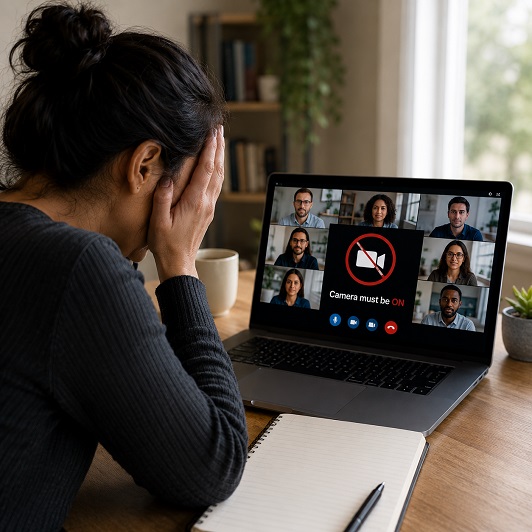
The issue came to a head during a remote training session on 24 August 2023. Feeling, in her words, “super anxious”, Ms Tait asked if she could leave her camera off. Instead, she was told to “start with it on and to see how she went”. According to the tribunal, she was unable to cope and left the session. She later went on long-term sick leave with work-related stress and anxiety.
Why Did The Tribunal Rule Against The Employer?
The tribunal did not conclude that Holiday Extras had ignored Ms Tait’s health concerns altogether. Throughout her employment, the company had introduced various temporary measures, including phased returns, reduced hours and other forms of support.
However, the judges found that several longer-term adjustments that would have reduced the disadvantage she experienced had not been implemented, despite being practical and reasonable.
Employment Judge Liz Ord wrote: “[Holiday Extras] did not allow the requested adjustment on 24 August 2023, when they were first made aware of [Ms Tait] being overwhelmed.”
The judgment also said: “Nonetheless, we take the view that the adjustment was reasonable and should have been put in place from 24 August 2023.”
The tribunal also found that Holiday Extras should have made greater use of chat and email work, rather than requiring Ms Tait to spend such a high proportion of her working day on telephone calls, concluding that these changes could have been accommodated without creating significant operational difficulties across a team of more than 50 travel consultants.
What The Decision Does And Does Not Mean
Although many headlines have suggested that employers can no longer insist staff switch on their cameras during online meetings, that is not actually what the tribunal decided.
In fact, the ruling was based on the employer’s legal duty under the Equality Act 2010 to make reasonable adjustments for an individual employee whose disabilities placed her at a substantial disadvantage.
Importantly, the tribunal did not uphold every adjustment Ms Tait requested. Some proposals, including a one-hour transition period whenever moving from chat work back to telephone calls, were rejected because the tribunal accepted that they would have had too great an operational impact.
The judgment therefore reinforces an established legal principle rather than creating a new one. In short, employers are expected to consider reasonable adjustments based on an individual’s circumstances, balancing the needs of the employee against the practical requirements of the organisation.
Why Remote Working Changes The Conversation
The case also illustrates how employment law continues to adapt to increasingly digital workplaces. For example, reasonable adjustments have traditionally focused on physical working environments, such as adapted workstations, accessible buildings or specialist equipment. As remote and hybrid working have become more common, however, digital workplace practices are receiving the same level of scrutiny.
Video meetings, online training sessions, communication platforms and virtual collaboration tools now form part of many employees’ everyday working environment. For some people, appearing on camera may be routine. For others, particularly those with certain disabilities or neurodivergent conditions, it can create genuine barriers to participation.
The tribunal accepted that, in Ms Tait’s circumstances, requiring her to appear on camera placed her at a substantial disadvantage compared with colleagues who did not experience the same difficulties.
What Does This Mean For Your Business?
For businesses, the judgment is an important reminder that workplace inclusion extends beyond the physical office. Policies governing video meetings, communication methods and remote collaboration should be considered in the same way as any other workplace practice when assessing whether reasonable adjustments may be required.
It’s worth noting here that the decision should not be interpreted as preventing employers from asking staff to switch on their cameras during meetings. Rather, it reinforces the need to consider individual circumstances, explore practical alternatives and document the reasons behind any decisions. Employers are not required to agree to every request, although they are expected to demonstrate that adjustments have been properly evaluated rather than dismissed on general operational grounds.
The case also highlights the importance of meaningful dialogue between managers and employees. Temporary support measures can be valuable during periods of ill health, but organisations should also consider whether those adjustments offer a sustainable longer-term solution. As remote and hybrid working continue to evolve, businesses that build flexibility into their management practices are likely to be better placed to support employees, reduce legal risk and create more inclusive digital workplaces.