
Could Seawater Supply Nuclear Fuel For 50,000 Years?
US clean technology startup Fluxnium is developing a way to collect uranium from seawater, targeting a resource potentially large enough to support nuclear generation for tens of thousands of years while attempting to reduce the environmental damage associated with conventional mining.
Looking To The Ocean
Nuclear power can provide electricity with low emissions over its lifetime, but its fuel still needs to be sourced and processed. As countries consider expanding nuclear generation, securing uranium supplies without increasing environmental damage becomes part of the sustainability challenge.
However, the International Atomic Energy Agency estimates that the oceans contain approximately four billion tonnes of uranium. Although that resource is enormous, it’s actually spread through seawater at very low concentrations, making collection difficult and potentially expensive.
The 50,000-year figure given by Fluxnium shows the scale of the resource against assumed consumption, rather than a quantity the company has proved it can recover. Higher nuclear demand would change how long it could last, while the amount available economically remains a separate question.
How Would Fluxnium Collect It?
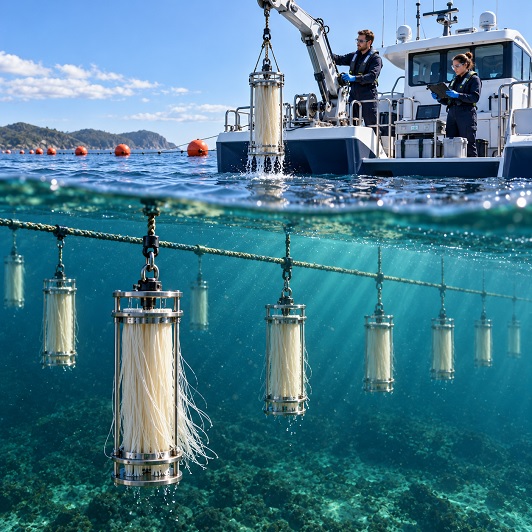
Fluxnium’s approach uses specially engineered polymer fibres that attract dissolved uranium as seawater moves past them. This is adsorption, meaning uranium attaches to the material, rather than being extracted by digging up and processing ore.
The fibres are deployed on offshore lines similar to those used by seaweed and mussel farms, then retrieved for processing and reuse. The company describes its approach as uranium “passively adsorbed from seawater on proven aquaculture infrastructure”.
After collection, the uranium is removed from the fibres and purified into yellowcake, a uranium concentrate sold into the existing fuel supply chain. It would still require further processing before use in a reactor, so the innovation concerns the source of the raw material.
What Is Different About This Attempt?
Scientists have actually researched uranium extraction from seawater for decades, and US national laboratories have already demonstrated fibres collecting uranium under natural seawater conditions.
Fluxnium is building on that work, focusing on fibre design, manufacturing and deployment to improve the economics. The company’s work to increase the surface area available to capture uranium could allow each deployment to collect more material. Reusing fibres could also spread their manufacturing cost across several collection cycles, provided they remain effective after processing and exposure to marine conditions.
The company’s website describes a “cost projected to match conventional mining”, which makes clear that competitiveness remains a projection. The evidence needed now is consistent performance and a credible total cost across offshore operations, processing and replacement materials.
The Importance Of Fuel Security
The appeal also reflects concerns about dependence on overseas uranium supplies. The US Energy Information Administration reports that “U.S. material accounted for 7 per cent of total deliveries in 2025”, demonstrating how heavily American nuclear operators relied on foreign-origin uranium.
However, that dependence shouldn’t automatically be presented as reliance on hostile countries. For example, Canada (which some would say is now regarded as a hostile country by the Trump administration) supplied 32 per cent of deliveries, Kazakhstan 28 per cent and Australia 15 per cent, giving a more balanced picture of the existing market.
The EIA also records a weighted-average purchase price of US$58.46 per pound in 2025, up 11 per cent from 2024. That figure combines different contracts, so it should not be confused with a current spot price or treated as directly equivalent to a startup’s projected production cost.
Better For The Environment?
Avoiding excavation and mine tailings, the waste left after processing ore, could reduce some impacts associated with conventional uranium mining. Collecting material through passive seawater flow could also avoid the energy needed to pump enormous quantities of water through a treatment plant.
However, passive collection doesn’t make the whole operation impact-free. For example, manufacturing the fibres, installing offshore equipment, operating vessels and processing the collected uranium all require resources, while marine deployments would need assessment for effects on habitats and other sea users.
A meaningful comparison would, therefore, need to cover the full production process and the amount of usable uranium delivered. It would also need to keep fuel extraction separate from electricity generation, because seawater sourcing would not remove the need to manage spent nuclear fuel.
What Does This Mean For Your Business?
For businesses seeking dependable low-carbon electricity, Fluxnium represents a possible improvement further up the energy supply chain. It is not an immediate source of cheaper power, and the size of the ocean resource shouldn’t influence purchasing decisions without evidence that the technology can deliver reliably and affordably.
The broader lesson is to examine where a sustainability innovation reduces harm and where it introduces new demands. A process that avoids mining may still consume substantial materials or energy elsewhere, so procurement teams should seek comparisons based on equivalent output, including maintenance, transport and waste management.
Successful development could give nuclear operators another fuel source while reducing pressure for some new extraction projects on land. For now, though, the important milestones are repeatable offshore results, independently assessed environmental performance and costs that hold up beyond trials, turning an impressive resource estimate into a practical contribution to cleaner energy.