
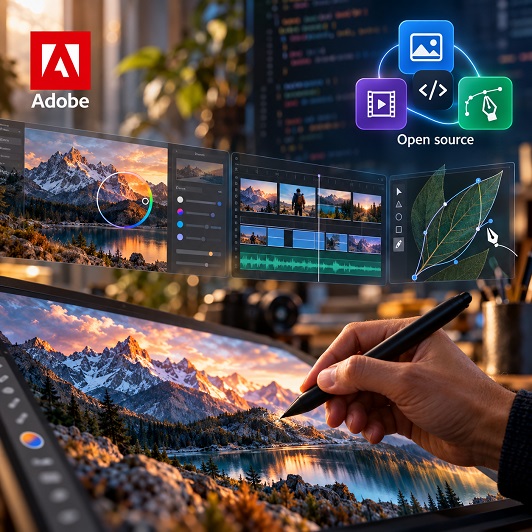
Developer Uses AI To Build Free Adobe Alternatives
Atlanta-based developer Brandon Thomas says he has used AI to build free alternatives to seven Adobe applications, turning frustration with subscription cancellation fees into a project that could widen access to creative software, although the tools remain far from proven professional replacements.
What Has He Built?
The applications cover photo editing, video production, illustration, page design and PDF work. Released through Thomas’s Artcraft company, they include Photocraft, Filmcraft and Vectorcraft, which aim to offer alternatives to Photoshop, Premiere and Illustrator.
Lightcraft, Effectcraft, Designcraft and Printcraft target Lightroom, After Effects, InDesign and Acrobat Pro respectively. Thomas says he used Anthropic’s Claude Opus 5.5 to help develop them in Rust, a programming language used to build native applications.
As well as being free to use, the applications are open source, meaning anyone can inspect their code, make changes or contribute improvements. This gives users with the necessary technical skills more freedom to adapt the software to their needs, although most businesses would still rely on developers to maintain it and fix problems.
Why Take On Adobe?
Thomas presents the project as a response to the restrictions and costs of subscription software. For example, in his Reddit announcement, he writes, “No more subscriptions with cancellation fees. These are yours to own forever.”
That frustration has a wider backdrop. Back in June 2024, the US government actually sued Adobe over allegations that it concealed early termination charges and made subscriptions unnecessarily difficult to cancel.
Adobe announced a settlement in March 2026 involving US$75 million in payments and US$75 million in free services for qualifying customers. The proposed order also required clearer disclosure of cancellation fees and simpler cancellation arrangements. Adobe disputed the allegations and denied wrongdoing.
The dispute helps explain the appetite for these alternatives, particularly among occasional users who may struggle to justify recurring payments. Whether they can switch comfortably will depend on the work they need to complete and how reliably the new applications handle it.
How Much Has AI Changed Development?
Thomas argues that AI assistance allows an experienced developer to attempt work that would previously have required substantially more resources. He describes himself as a software industry veteran with 15 years’ experience, including about a decade working with Rust.
He also rejects the suggestion that the applications will be abandoned after attracting attention, stating, “We have a team building popular software for filmmakers, so supporting this is fully funded.”
Although Thomas says the project is fully funded, its long-term costs will depend on how much work is needed to make the applications reliable and keep them running. AI may speed up coding, but developers still need to test the software with different files and computers, fix problems and make sure it can handle the work users depend on it for.
Are The Applications Ready?
Despite Thomas’s ambitions, the project’s own documentation acknowledges that Photocraft isn’t yet ready to replace Photoshop in everyday professional work. It’s currently in early alpha, an initial stage of development, with missing tools and limitations in text editing, professional tasks and support for plug-ins, which add extra features to an application.
Even where familiar menu options are available, they may not work as users expect. For example, a designer could recognise the layout but still struggle to open a client’s file, make the required changes or export the finished work correctly. Recreating the appearance of an established application is only part of making it a useful replacement.
It seems some people commenting beneath Thomas’s announcement on Reddit have also reported crashes and problems handling video files. Those reports don’t establish how every user will find the software, but they seem to suggest businesses should test it with copies of their own files before relying on it for customer work.
Who Will Keep Them Running?
Thomas says Artcraft’s separate business selling access to AI image and video models will help cover development costs. The creative applications themselves are offered without subscription charges, while users are encouraged to report bugs and contribute fixes.
Community contributions could improve the tools, but someone still needs to review changes, maintain releases and resolve problems. The ability to copy and develop the source independently reduces dependence on one supplier, although it does not guarantee that another team will take over if support ends.
What Does This Mean For Your Business?
For businesses interested in reducing software costs, the sensible starting point is perhaps a limited trial using copies of representative files. Staff should check whether documents open correctly, edits survive saving and exports meet customers’ requirements. A free application offers little saving if employees spend longer repairing files or repeating work.
The comparison should also include training, support and collaboration. An alternative may suit occasional image editing while remaining unsuitable for a team exchanging complex projects with external agencies. Keeping existing tools available during testing allows businesses to identify useful opportunities without putting deadlines or original work at risk.
The broader significance is that AI may make it easier to build competing software and challenge established subscription models. However, the work that earns customers’ confidence continues after the first release. Businesses should judge these applications by reliable results, compatibility and sustained support, rather than assuming that rapid development means the difficult parts of software are already solved.