
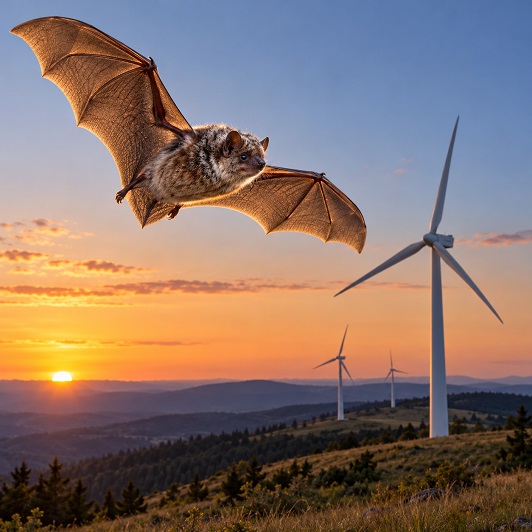
Wind Farm Bat Deaths Rise, But Better Timing Could Save Lives
US researchers estimate that onshore wind turbines killed more than 1.5 million bats a year from 2021 to 2024, but evidence from France suggests that stopping blades when bats are most active could prevent many of those deaths.
How Big Is The Problem?
A study published in October in the Proceedings of the National Academy of Sciences estimates that 18.7 million bats from ten species died at onshore wind farms across the United States between 1981 and 2024. According to the research, the annual toll rose as wind power expanded, with three migratory species accounting for most of the deaths.
To arrive at that figure, researchers drew on 499 monitoring reports from 277 wind farms. Simply counting the bats found beneath turbines would miss animals hidden in vegetation or carried away by scavengers before anyone searched, so the team used records from monitored sites to estimate how many bats were likely to have died across the wider industry. The researchers were therefore able to put the likely figure between 13.3 million and 25.7 million.
Which Bats Are Most At Risk?
The hoary bat accounted for an estimated 6.7 million deaths, followed by the eastern red bat and the silver-haired bat. All three roost in trees and migrate, so the risks they face can change as they move between feeding grounds and seasonal habitats.
The US figures show how many bats may have died, but they can’t show how far each species’ population has fallen because that would require reliable information about how many animals were present to begin with and how successfully they breed. In the UK, for example, British bat populations are known to have grown over the longer term, but those trends don’t say much about migratory species encountering turbines in North America.
When Should Turbines Stop Turning?
One reason there is scope to reduce deaths is that bats don’t fly around turbines equally often in all conditions. For example, on a warm night with light winds, bats may be active while a turbine is generating relatively little electricity. If operators know when those conditions occur at their site, they can stop the blades during the riskiest periods and keep generating at other times.
French researchers have actually tested how well this works by comparing deaths before and after wind farms introduced operating rules based on local bat activity, temperature and wind speed. Their strongest comparison, covering 16 wind farms, included sites that continued operating as before. They found that deaths fell by around 83 to 84 per cent in two groups of bats.
How Much Electricity Would Be Lost?
To find out how much electricity wind farms might lose by stopping turbines when bats are most active, a second French research team analysed recordings of bat calls from 123 turbines. The researchers estimated that, between mid-April and mid-November, operators could keep the blades still during periods that accounted for 90 per cent of recorded bat activity. Their model put the resulting loss at around 3.5 to 4.9 per cent of annual electricity production.
The 90 per cent figure refers to bat activity, so it doesn’t show how many deaths those shutdowns would prevent. To find that out, operators could use recordings to decide when to stop their turbines, then compare the number of dead bats found beneath them before and after the change. That would show whether the chosen hours offered enough protection or whether a different schedule might work better.
Would The Same Approach Protect Birds?
Although the French field study found that timed shutdowns reduced bat deaths, it found no similar benefit for birds migrating at night. Bird strikes are also a concern in the UK, where Science Focus reported in 2022 that turbines were estimated to kill between 10,000 and 100,000 birds a year. The wide range gives some idea of how uncertain that figure was.
One possible way to protect birds is to make the moving blades easier to see. In Norway, researchers painted one blade black on each of four turbines and recorded a fall of about 70 per cent in bird deaths relative to those at turbines left unpainted. The trial was small, but it gives researchers a reason to test the idea at other sites. For bats, the clearest evidence so far points to changing when the blades turn.
What Does This Mean For Your Business?
For businesses buying wind power or investing in a particular project, it is reasonable to ask what the operator knows about wildlife at that site. A useful answer would explain how surveys influenced the choice of location, when turbines stop to protect bats and whether monitoring shows that fewer animals are dying as a result.
Those answers can also help a business decide what it can fairly say about the electricity it buys. For example, a supplier might report that its turbines stopped for 200 hours to protect bats. That tells customers the operator took action, but the more useful question is whether those hours coincided with the nights when bats were flying near the blades. A shorter, well-timed shutdown could protect more bats while sacrificing less electricity.
For operators, comparing bat activity, deaths and electricity output over several seasons would help identify which shutdowns are worth keeping and where a change in timing might work better. For customers, that offers a more meaningful sign of progress than the number of hours a turbine stood still. The encouraging finding from France is that operators can reduce bat deaths substantially by paying closer attention to what happens at their own sites and changing when the blades turn.