
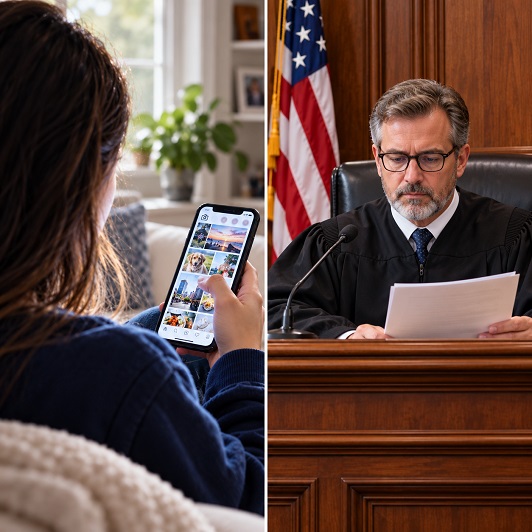
Meta Settles Teen’s Claim Over Addictive Social Media Design
Meta has settled with a teenager who alleged that Instagram and Facebook encouraged compulsive use and contributed to her mental health problems and disordered eating, leaving Snapchat’s parent company, Snap, as the only defendant expected to face a jury in the Los Angeles trial.
Why Did Meta Settle?
Jury selection was already under way when lawyers for the 18-year-old, identified in court as K.D.B., confirmed the settlement on 30 October. Meta had reached an agreement days earlier with S.J., a 16-year-old whose claims were due to be heard in the same trial. Both teenagers had previously settled with TikTok and YouTube. The terms of Meta’s settlement with K.D.B. were not disclosed, and neither side gave a specific reason for reaching an agreement at that point.
What the settlement changes is who must answer the allegations in this trial. For example, a jury could still hear how the teenagers say Snapchat affected them, but it won’t decide whether Facebook or Instagram caused the harm K.D.B. described. Meta denies designing its services to addict young people, and Snap also disputes the claims against it.
Why Is The Design Of The Apps Being Looked At?
The teenagers’ claims concern what happens after someone opens an app, including how easy it is to stop using it. For example, autoplay starts another video without asking the viewer to choose one, while infinite scroll keeps adding posts as someone moves down a feed. Both remove a natural stopping point when the user might otherwise put the phone down.
That helps explain why the scope of this case goes beyond whether a teenager saw a particular harmful post. Someone who opens an app to watch a clip sent by a friend can still be watching half an hour later, even if there was nothing troubling about the clip itself. The teenagers allege that features encouraging them to stay or return helped turn childhood use into a compulsion that damaged their health.
What Does The Evidence Say About Harm?
As a review by the US National Academies of Sciences, Engineering, and Medicine explains, the effect of social media on a teenager can depend on how they use it. Someone struggling to find support at school might find it easier to talk to friends online. For someone already worried about their appearance, however, scrolling through images that invite comparison may make those worries worse.
That variation makes it difficult to draw conclusions from screen time alone. For example, a teenager who feels low might go online at night for company, then lose sleep because they stay up scrolling. Knowing how long they spent on the app doesn’t tell researchers what first prompted them to use it or how they felt afterwards. The review found too little evidence to conclude that social media caused changes in teenagers’ health across the population. In an individual case, the question is whether particular features contributed to the harm that person experienced.
How Has Meta Responded?
Meta disputes the claim that it designed its apps to encourage compulsive use and points to steps it has taken to protect younger users. When it introduced Instagram Teen Accounts in 2024, for example, teenagers received a reminder after an hour’s use each day, while a sleep mode muted notifications overnight. Meta said at the time that “teens under 16 will need a parent’s permission to change any of these settings to be less strict”.
These features give teenagers a prompt to take a break and reduce the chance that a late-night alert will draw them back to the app. The timing’s important because both claimants began using social media years before Instagram introduced Teen Accounts. To understand their experiences, we need to know which safeguards were available when they were growing up.
Why Does This Case Still Matter?
The Los Angeles case was chosen from thousands of similar lawsuits because it gave both sides a chance to see how a jury would respond to arguments about the way the apps were designed. In March, a jury in a separate trial found Meta and YouTube negligent and awarded another young woman $6 million. That verdict applied to her case alone. The terms of K.D.B.’s settlement have not been disclosed.
With Meta’s part in the current trial over, attention is now turning to Snap. If the trial goes ahead as expected, a jury will hear the teenagers’ claims about Snapchat and the company’s response. Other claimants and companies may use that outcome to help decide whether to settle similar cases or take them to trial.
What Does This Mean For Your Business?
For UK businesses designing or commissioning apps that young people use, the case raises a practical question. If teenagers spend longer watching videos after a business switches on autoplay, how does it know they’re finding the service more useful? Viewing figures will rise whether someone chooses another video or simply keeps watching because it has already started.
A business offering online training could learn more by giving learners a choice at the end of each lesson. If they decide to stop because they’ve learnt what they came for, a shorter visit may actually be a sign that the service worked well. Asking whether they achieved their aim gives the business a better basis for improving the app than counting minutes alone.
As for this particular case, the settlement means a jury will not decide whether Meta’s design choices harmed K.D.B. The question businesses can answer for themselves is what happens when a young user has finished what they came to do. Giving them a natural place to stop leaves the decision about whether to carry on in their hands.