
Laser Mosquito Control Could Cut Chemical Use
A portable device that uses LiDAR, radar, AI and a laser to detect and kill mosquitoes is now being sold commercially, raising a much bigger question than whether people will pay around US$1,000 to keep insects away from their patios and instead focusing attention on whether precision technology could eventually reduce our reliance on chemical mosquito control.
How Does The Laser System Work?
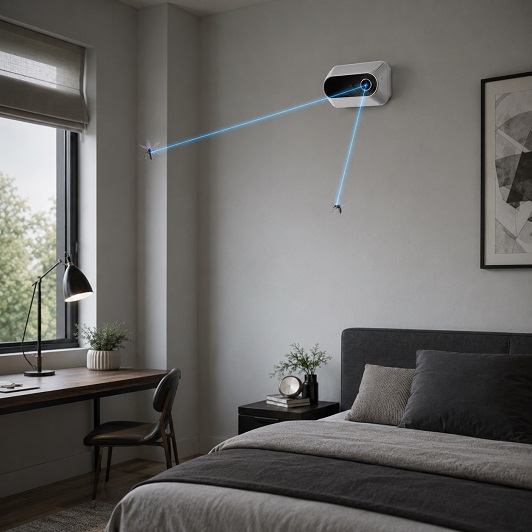
Chinese company Photon Matrix describes its product as the “world’s first portable laser mosquito air defense”, with separate infrared and blue-laser versions for indoor and outdoor use. The company says the system scans the surrounding area with LiDAR (a laser-based technology that measures distances and maps objects in its surroundings), measures the distance to the background and looks for changes caused by flying insects.
If an insect matches the expected characteristics of a mosquito, a galvanometer-controlled laser is directed along the same optical path to hit it. Photon Matrix says its six-metre system can detect flying insects between 2mm and 20mm moving at up to one metre per second, while power consumption is rated at no more than 20W.
The company describes the approach as “a clean, chemical-free solution” without sprays, odours or harmful residues. The infrared model is currently listed at US$988 and the outdoor blue-laser version at US$1,088, with both offered on a pre-order basis and delivery expected within 120 days.
Why Chemical-Free Mosquito Control?
Mosquito control is not simply about avoiding bites. Malaria alone caused an estimated 282 million cases and 610,000 deaths worldwide in 2024, according to the World Health Organization, with the African Region accounting for 94 per cent of cases and 95 per cent of deaths.
Chemical insecticides remain one of the most important defences, particularly through treated bed nets and indoor residual spraying, and any new technology would need to complement rather than displace proven public-health measures. However, resistance is now becoming a serious problem, with the World Health Organization (WHO) reporting pyrethroid resistance in 48 of 53 countries that supplied relevant data.
This makes the idea of targeting individual mosquitoes without repeatedly spraying chemicals particularly interesting from an environmental point of view. By identifying a mosquito before acting, the system could reduce unnecessary exposure for people, other insects and the wider environment, while also reducing reliance on the same insecticides over and over again.
Has Anything Like This Been Tried Before?
Photon Matrix isn’t the first company to explore using lasers to control mosquitoes. A larger system called the Photonic Fence, originally developed by US-based Intellectual Ventures, uses cameras and infrared light to spot insects flying through an area and a laser to target mosquitoes.
In tests published in Scientific Reports in 2024, the laser system was reported to be highly effective. When the laser was switched off, researchers recovered 38.3 per cent of the mosquitoes released into the test area, but when it was switched on, only 0.86 per cent remained. The system also detected nearby orchid bees without targeting them, suggesting it may be able to kill mosquitoes while leaving other insects alone.
Also, Australia’s World Mosquito Program, owned by Monash University, uses another chemical-free method by releasing mosquitoes carrying the naturally occurring Wolbachia bacterium, which makes them less able to spread viruses such as dengue.
Could Lasers Help In Africa?
The biggest potential benefit could be in Africa, where malaria remains a major health threat and where most of the world’s malaria deaths occur. If laser systems became cheaper, tougher and practical to run from solar power or batteries, they could eventually be tested around African homes, clinics, schools and other high-risk locations.
For now, though, there is no evidence that Photon Matrix has been tested as a malaria-control tool in Africa, or that a six-metre consumer device could reduce disease transmission across a community. Cost, reliability, safety, maintenance and the number of units needed would all have to be proven first.
What Does This Mean For Your Organisation?
For organisations looking at more sustainable pest control, the main opportunity is greater precision, because technologies such as LiDAR and AI can identify a mosquito before acting rather than treating a whole area with chemicals.
Using fewer insecticides could reduce contamination and limit harm to beneficial insects, although laser systems still require electricity, electronics and manufactured components, so their overall environmental impact would need to be properly assessed.
Photon Matrix could, therefore, be best seen as an early example of a wider move towards more targeted mosquito control, with the real sustainability potential depending on whether these systems can become affordable, independently tested and practical enough to complement proven methods.