
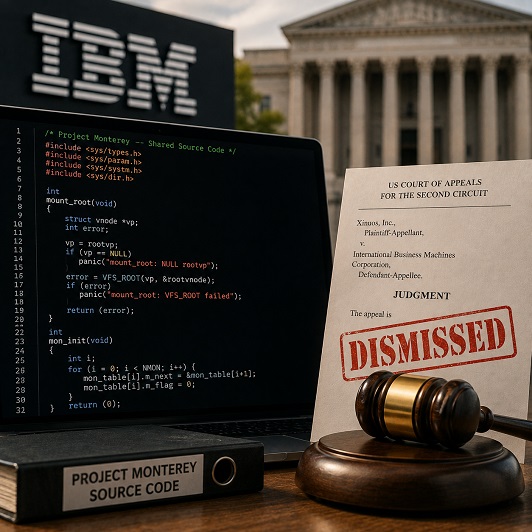
28-Year Linux Code Fight Nears Its End
A US appeals court has upheld the dismissal of the last live claim in a decades-long dispute over IBM’s use of code from Project Monterey, bringing one of the technology industry’s longest-running legal battles close to an end while removing another layer of uncertainty around Linux and open-source software.
Where Did The Dispute Begin?
The story goes back to 1998, when IBM and The Santa Cruz Operation, or SCO, launched Project Monterey, a joint venture intended to create a family of UNIX-based operating systems capable of running across different processor architectures.
Under the project’s Joint Development Agreement, both companies shared technology and licensed code to each other. Linux was growing rapidly at the time, however, and IBM eventually terminated the project in 2001.
SCO later accused IBM of improperly using source code obtained through Project Monterey. Litigation began in 2003 and continued through bankruptcy proceedings, appeals and settlements, with Xinuos eventually acquiring much of SCO’s software business in 2011.
What Was Xinuos Claiming?
Xinuos brought its own case against IBM and Red Hat in 2021, alleging that IBM had incorporated Project Monterey source code into its AIX and other operating systems without having the necessary rights.
The latest ruling makes an important distinction that is easy to miss in descriptions of the case as a fight over who “owns Linux”. The appeals court says IBM does not dispute that Xinuos owns the copyrighted code or that IBM took Project Monterey code and incorporated it into products it continues to develop and sell.
Instead, the dispute centres on whether IBM had a valid licence allowing it to use that code after Project Monterey ended. As the court explains, the case concerns “IBM’s right to use the Project Monterey code”, making it a dispute about the existence of a licence rather than ownership of the code itself.
Why Did Xinuos Lose?
The US Court of Appeals for the Second Circuit did not decide whether IBM was ultimately right about having permission to use the code. Instead, the case failed because Xinuos actually brought the claim too late.
Copyright infringement claims can normally be brought within three years of an infringing act, but disputes over an underlying right, such as whether a licence existed in the first place, can accrue only once.
The judges concluded that the contested action was IBM taking the code after Project Monterey ended in 2001. The order describes IBM’s taking of the code as a “one-time event”, meaning the clock for challenging IBM’s claimed right to use it started long ago.
Even if Xinuos were given the benefit of arguing that it did not know IBM claimed a licence until it acquired SCO’s assets in 2011, the court said its 2021 lawsuit would still fall outside the Copyright Act’s three-year limitation period.
A Long Legal Road
SCO first sued IBM in Utah in 2003, later entered bankruptcy and eventually settled its remaining claims against IBM in 2021 for US$14.25 million.
Xinuos objected to that settlement and pursued its own case, while its claims against Red Hat were later dismissed. A federal district court granted summary judgment to IBM in 2024, with final judgment following in April 2025.
On 10 August 2026, a three-judge Second Circuit panel affirmed that judgment and said Xinuos’s remaining arguments were “without merit”.
It’s worth noting here that this latest ruling is a summary order, meaning it does not create binding precedent for future cases, and Xinuos has indicated that it intends to seek a rehearing before the full appeals court. Such reviews are rare, so the dispute now appears to be approaching its end.
Why Does This Matter?
Linux, the open-source operating system that powers a huge amount of modern computing infrastructure, sits underneath everything from servers and cloud platforms to smartphones, networking equipment and embedded devices, so any long-running dispute involving code associated with it inevitably creates concern.
This latest ruling doesn’t declare that IBM was right about the licence, nor does it decide who owns Linux. What it does is make it much harder for this particular dispute over Project Monterey code to continue through the courts, reducing a lingering source of legal uncertainty for IBM and the wider open-source ecosystem.
What Does This Mean For Your Business?
The key point for businesses here is that open-source software doesn’t remove the need for careful intellectual property management. Organisations contributing code, acquiring software companies or entering joint-development projects need clear records showing where code originated, what licence governs it and what rights survive when a partnership ends.
The case also demonstrates how software decisions can create legal consequences lasting far longer than the technology projects that produced them. Project Monterey ended in 2001, yet arguments over rights to its code have continued for another quarter of a century.
For businesses building products from proprietary, third-party and open-source software, accurate software inventories, licence records and contribution histories can help prevent expensive disputes years later.