
Amazon Takes On Starlink
Amazon says it now has enough satellites in orbit to begin commercial broadband services later this year, marking the point at which its long-awaited satellite internet network moves from development into operation and giving businesses, governments and consumers the prospect of meaningful competition to SpaceX’s Starlink.
Reaching The Starting Line
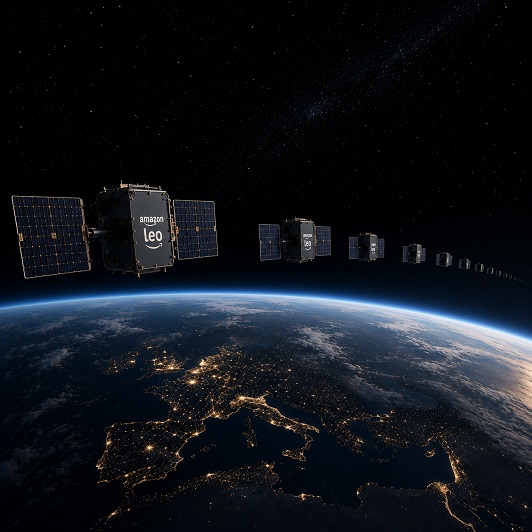
Amazon has announced that its Amazon Leo satellite constellation has now grown to 396 satellites following the successful launch of 29 additional spacecraft aboard a United Launch Alliance Atlas V rocket.
The company says this is enough to begin offering initial commercial broadband services later this year, meeting the target it previously set for 2026.
Although the number may seem modest compared with some satellite constellations, it represents an important milestone because it provides sufficient coverage to support continuous service across an initial operating region while Amazon continues deploying more satellites.
As Chris Weber, Vice President of Business and Product for Amazon Leo, said following the latest launch, the constellation now has “enough to support continuous service across initial latitudes.”
Amazon describes Leo as “its low Earth orbit satellite network”, whose mission is “to deliver fast, reliable internet to customers and communities beyond the reach of existing networks.”
A Long Way Behind Starlink
Despite reaching this important milestone, it seems Amazon is also realistic about the scale of the challenge ahead.
SpaceX has spent almost a decade building Starlink into the world’s largest satellite broadband network, with roughly 10,000 satellites currently in orbit serving millions of customers across more than 100 countries.
By comparison, Amazon’s 396 satellites represent only the beginning of its deployment programme.
Coverage will initially be limited, with service starting across selected mid-latitude regions before gradually expanding as additional launches take place. Customers in many parts of the world will therefore need to wait until much larger numbers of satellites are operational before the network offers near-global availability.
However, Amazon has already secured more than 100 launches and plans to increase deployment significantly over the coming years.
Building A Global Network
The latest launch also marks the end of Amazon’s initial Atlas V campaign. Future deployments will increasingly rely on larger rockets, including United Launch Alliance’s Vulcan launch vehicle, which can carry substantially more satellites per mission and accelerate the growth of the constellation.
According to Amazon, Vulcan will “carry even larger Leo payloads and help increase our deployment rate.”
The company has already established dedicated launch infrastructure to support the faster pace of future missions, with hundreds of completed satellites reportedly ready for deployment.
Although this marks an important milestone, Amazon’s long-term ambition extends far beyond today’s constellation. The company plans to deploy more than 3,200 first-generation satellites over the next few years, creating a global broadband network capable of serving homes, businesses, governments and remote communities.
Why Competition Matters
The significance of Amazon Leo actually extends quite a bit beyond simply offering another way to access the internet.
Satellite broadband has become strategically important for everything from rural connectivity and disaster recovery to maritime communications, aviation and military resilience.
Until now, Starlink has established a commanding lead in this rapidly growing market, making it the default choice for many organisations requiring reliable internet where conventional fixed-line or mobile networks are unavailable.
A credible alternative could introduce greater competition, potentially encouraging lower prices, broader coverage, faster innovation and improved resilience for customers who may prefer not to depend on a single supplier.
Competition also encourages innovation. As providers compete for customers, improvements in speed, reliability, equipment and service quality often arrive more quickly than they would in a market dominated by one major player.
Considerable Work Ahead
Although Amazon seems very pleased that it has reached an important milestone, there is clearly considerable work ahead before Leo becomes a genuine rival to Starlink.
For example, the company must continue launching thousands more satellites while expanding its ground infrastructure, manufacturing capacity and customer equipment.
It also faces some practical challenges beyond its own control. For example, some future launch vehicles are still completing development, while maintaining an ambitious deployment schedule will depend upon reliable access to launch services over several years. That said, Amazon nevertheless seems confident about the path ahead.
Melissa Wuerl, Amazon Leo Director of Launch Systems, said: “With hundreds of flight-ready satellites standing by at the Cape and a new, dedicated vertical integration facility ready to support Leo Vulcan 1 and subsequent missions, we have a clear path to increase launch and deployment cadence, helping us quickly expand network coverage following an initial service rollout later this year.”
What Does This Mean For Your Business?
For businesses, Amazon Leo represents more than another satellite internet service. It signals a market that is becoming increasingly competitive at a time when dependable connectivity has become critical to almost every organisation.
Companies operating in rural locations, construction sites, agriculture, mining, offshore industries or other areas with limited terrestrial broadband could ultimately benefit from greater choice and improved resilience as additional satellite providers enter the market.
Competition may also encourage lower prices, faster innovation and improved service quality across the satellite broadband sector, while reducing dependence on any single provider for critical communications.
The wider significance extends beyond internet access alone. Satellite networks are becoming an increasingly important part of national infrastructure, supporting everything from emergency response and remote working to connected vehicles, logistics and future direct-to-device communications. Amazon still has a considerable distance to travel before Leo matches Starlink’s scale, but reaching the point where commercial services can begin marks the moment satellite broadband becomes a genuinely competitive market rather than one largely defined by a single dominant player.